Table of Contents
In Summary:
- Africa’s most active sovereign wealth funds are anchored by natural resource revenues, especially oil, gas and minerals, and play a growing role in stabilizing African economies.
- Countries like Nigeria, Angola, Algeria and Libya use their funds to manage commodity volatility, support infrastructure, and strengthen fiscal buffers against external shocks.
- Leading funds such as those of Botswana, Ghana and Rwanda increasingly focus on diversification, transparency and strategic investments beyond extractive sectors.
- Overall, active sovereign wealth funds are reshaping Africa’s economic landscape by promoting intergenerational wealth, investor confidence and sustainable growth.
Deep Dive!!
Monday, 21 December 2025 – Sovereign wealth funds have become one of Africa’s most strategic financial tools, helping governments convert natural resource revenues, foreign exchange surpluses, and long-term savings into sustainable national wealth. Across the continent, these state-owned investment vehicles are increasingly used to stabilize budgets, fund infrastructure, support economic diversification, and protect future generations from commodity price shocks.
This article ranks the Top 10 African countries with the most active sovereign wealth funds, drawing on verified data and reports from credible global and regional sources. It examines how these funds are structured, how actively they deploy capital, and the roles they play in shaping national development strategies, fiscal resilience, and Africa’s growing influence in global investment markets.
10. Ghana
Ghana’s sovereign vehicles have seen renewed attention as the country rebuilds fiscal buffers and attracts development finance. The Heritage Fund, seeded with oil revenues, and the Ghana Infrastructure Investment Fund (GIIF) are increasingly used to mobilise development capital for energy, ports and roads. In 2024–2025 these vehicles combined modest AUM with a rising pipeline of blended-finance deals focused on infrastructure and energy access, reflecting a pragmatic use of sovereign money to crowd in private capital. Ghana’s SWF architecture remains relatively small compared with regional heavyweights, but its deal activity and government prioritisation place it among Africa’s more active funds.
Ghana’s approach emphasises development impact, using concessional lines and public-private vehicles to leverage project finance rather than competing directly with commercial asset managers. That model has accelerated pilot projects and attracted DFIs to co-invest, particularly in renewable energy and logistics, giving Ghana growing relevance in continental SWF discussions despite limited headline assets.
9. Mauritius
Mauritius is notable less for a single giant SWF and more for serving as a domicile and conduit for pan-African investment structures, including funds that pursue sovereign-style mandates. The island’s financial centre, favourable treaty network and fund-domiciling infrastructure make it a key node for funds targeting African infrastructure and private markets. In 2024–2025 Mauritius hosted numerous fund vehicles, and local authorities promoted green-finance and blended instruments that position the jurisdiction as an active platform for sovereign and quasi-sovereign investment flows across the continent.
This gateway role means Mauritius plays an outsized part in activity even if the headline AUM of domestically-labelled sovereign funds is modest. Many African sovereign and pension investors use Mauritian structures to co-invest in regional projects, so the country’s relevance to sovereign activity is practical and structural rather than solely asset-centric.
8. Gabon
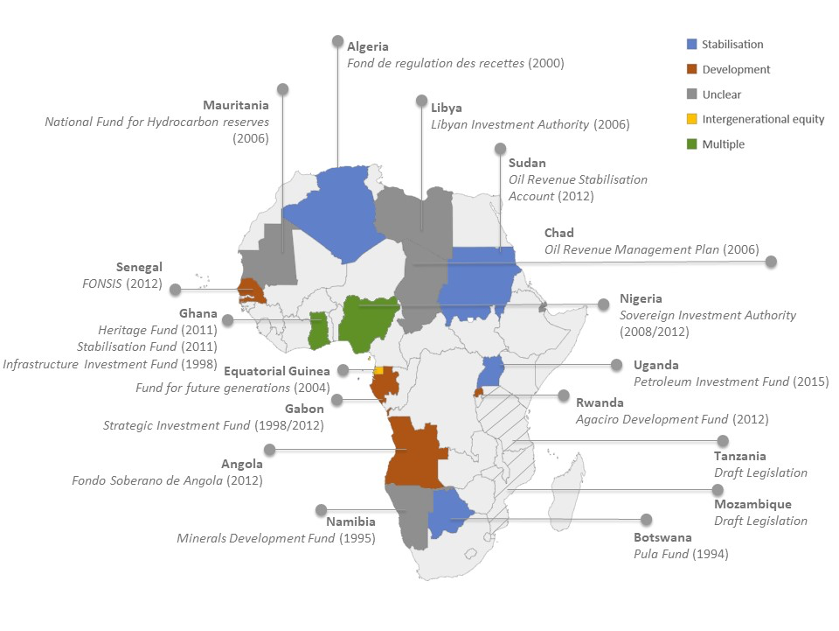
Gabon’s Fonds Gabonais d’Investissements Stratégiques (FGIS) has stepped up its development and diversification mandate through direct investments and strategic partnerships. In 2024–2025 FGIS emphasised local value-chain projects aimed at lowering oil dependence, supporting timber and mining value-add, and backing national supply-chain initiatives. While Gabon’s SWF remains modest in scale compared with continental leaders, its increased project execution and visibility in government industrial strategy make it an active player among Africa’s sovereign funds.
FGIS’s activity profile shows an SWF focused on strategic national projects rather than global portfolio diversification. That orientation creates tangible domestic impact, industrial parks, downstream processing and job creation, so Gabon’s sovereign vehicle registers as notably active in 2025 despite smaller AUM by global standards.
7. Botswana
The Pula Fund (managed by the Bank of Botswana) remains one of Africa’s older and more conservative sovereign vehicles, financed largely by diamond revenues. In 2024–2025 the Pula Fund continued its cautious accumulation and prudent governance approach, with public statements emphasising long-term capital preservation and strategic reserve management. Recent reporting highlights steady reserve rebuilding and policy work to ensure the fund’s role as a fiscal stabiliser as Botswana prepares for post-diamond diversification.
Botswana’s SWF model is conservative but impactful: it underpins fiscal stability and supports targeted investments in public infrastructure and human-capital development. That steady, low-risk posture keeps the Pula Fund prominent among Africa’s sovereign vehicles for stability and intergenerational savings rather than high-velocity dealflow.
6. Nigeria
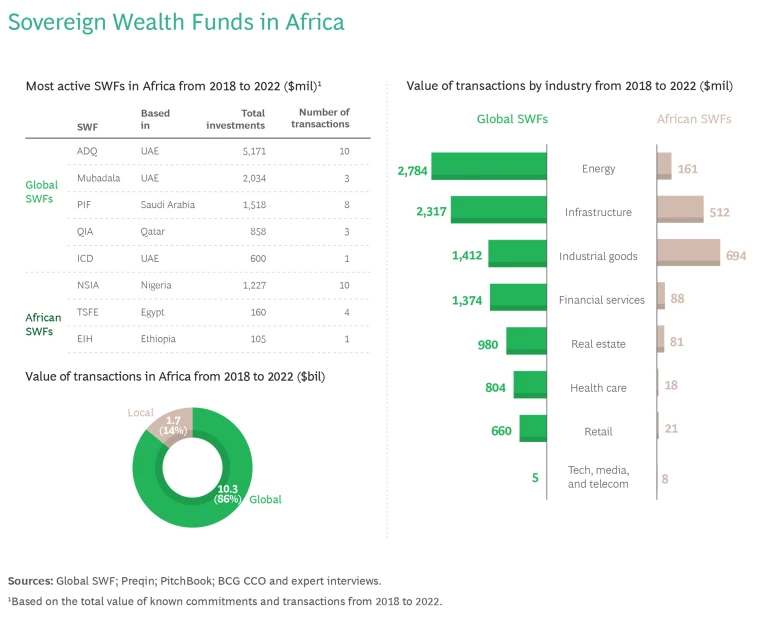
Nigeria’s NSIA has scaled materially since inception and by mid-2025 reported net assets in the low billions of dollars with an expanding development footprint. The NSIA operates multiple thematic funds, Stabilisation, Future Generations, and the Nigeria Infrastructure Fund, and in 2024–2025 it stepped up project financing for power, healthcare and logistics, co-investing with DFIs and local institutional partners. Nigeria’s size, hydrocarbon endowments and active domestic market mean NSIA’s operational activity is both visible and strategically important.
The NSIA’s deal activity in 2025 illustrated how sovereign vehicles can catalyse large national projects: it has backed energy transmission, hospital PPPs and industrial projects that leverage private capital. That practical, downstream focus on deliverable national infrastructure places Nigeria high on the “active SWF” list.
5. Angola
Angola’s FSDEA has been actively reshaping its portfolio in 2024–2025, reporting asset growth and announcing investments across energy, agriculture and financial instruments. Official FSDEA releases in 2025 documented a multi-percent rise in assets and a renewed mandate to channel oil receipts into diversification projects and international co-investments. This combination of domestic project funding and measured external allocation elevated Angola’s sovereign fund profile in 2025.
FSDEA’s operational shift toward domestic infrastructure and selective global exposure shows an SWF moving from passive reserves toward impact deployment. That active posture, combined with recent asset and profit growth reported by the fund, puts Angola among the continent’s most dynamically engaged sovereign investors.

4. Egypt
Egypt’s Sovereign Fund (TSFE) has grown into a major player across North Africa by actively managing state assets and pursuing industrial and tourism projects. By 2025 TSFE reported multi-billion assets under management, and the fund has been particularly visible in PPPs, airport and tourism investments, and restructuring state holdings for commercialisation. TSFE’s public disclosures and successive deals in 2024–2025 show a fund moving from asset consolidation to active domestic investment.
TSFE’s activity includes selling minority stakes, co-investing in industrial parks and partnering with international operators on tourism and infrastructure. That practical engagement, plus improved disclosure, makes Egypt’s sovereign vehicle one of Africa’s most active investment engines for national transformation.
3. Algeria
Algeria’s state investment vehicles have benefited from hydrocarbon windfalls and periodic attempts to formalise a strategic sovereign fund. In 2024–2025 official messaging and policy papers pointed to increasing use of reserves to support domestic industrial projects and to stabilise the macroeconomy, with an expanding remit for sovereign holdings. Algeria’s large resource base and emerging institutionalisation placed it prominently among active sovereign funds on the continent in 2025.
While Algeria’s formal SWF architecture differs from some peers, its scale of oil-backed external buffers and recent policy focus on investing in industry, energy transition and food security projects mark it as one of Africa’s more influential sovereign capital sources. This combination of scale and domestic deployment elevates Algeria’s rank in 2025.

2. Ethiopia
Ethiopian Investment Holdings consolidated state enterprises and strategic assets into a single, active investment vehicle that by 2025 had become Africa’s most-discussed emerging SWF. EIH controls stakes in flagship enterprises such as Ethiopian Airlines, Ethio Telecom and national transport and logistics assets, and public reporting in 2024–2025 emphasised large industrial partnerships and co-investments (for example the Dangote fertilizer project where EIH holds a state stake). Authorities report very large asset scales under EIH, making it one of the continent’s most consequential sovereign investment vehicles.
EIH’s model differs from commodity-fund SWFs: it acts as an active owner of national champions with a development mandate to industrialise and create jobs. That hands-on approach, combined with high-profile project deals and reported multi-billion balance sheets, positions Ethiopia near the top of the African SWF activity ranking for 2025.
1. Libya
The Libyan Investment Authority remains the continent’s largest sovereign fund by reported assets. Multiple reputable sources and SWF trackers list LIA among Africa’s biggest funds with asset estimates in the tens of billions, typically cited above $60–70 billion depending on valuation and the status of frozen overseas assets. Despite governance disruptions since 2011 and partial asset freezes, the LIA’s scale, global holdings and the UN/fund restructuring processes keep it as Africa’s top sovereign investor by size and potential deployment. Reuters and GlobalSWF reporting in 2025 reinforced Libya’s leading position in headline assets while noting ongoing sanctions and governance reform work.
Libya’s LIA is important not just for its balance sheet but because its eventual re-engagement with global markets and possible unfreezing of assets could reconfigure investment flows into Africa. The LIA’s portfolio, when fully mobilised, would be among the most consequential sources of capital for continental infrastructure and direct investments, and for that reason Libya tops the 2025 activity ranking despite its complex political and legal context.
We welcome your feedback. Kindly direct any comments or observations regarding this article to our Editor-in-Chief at [email protected], with a copy to [email protected].