Table of Contents
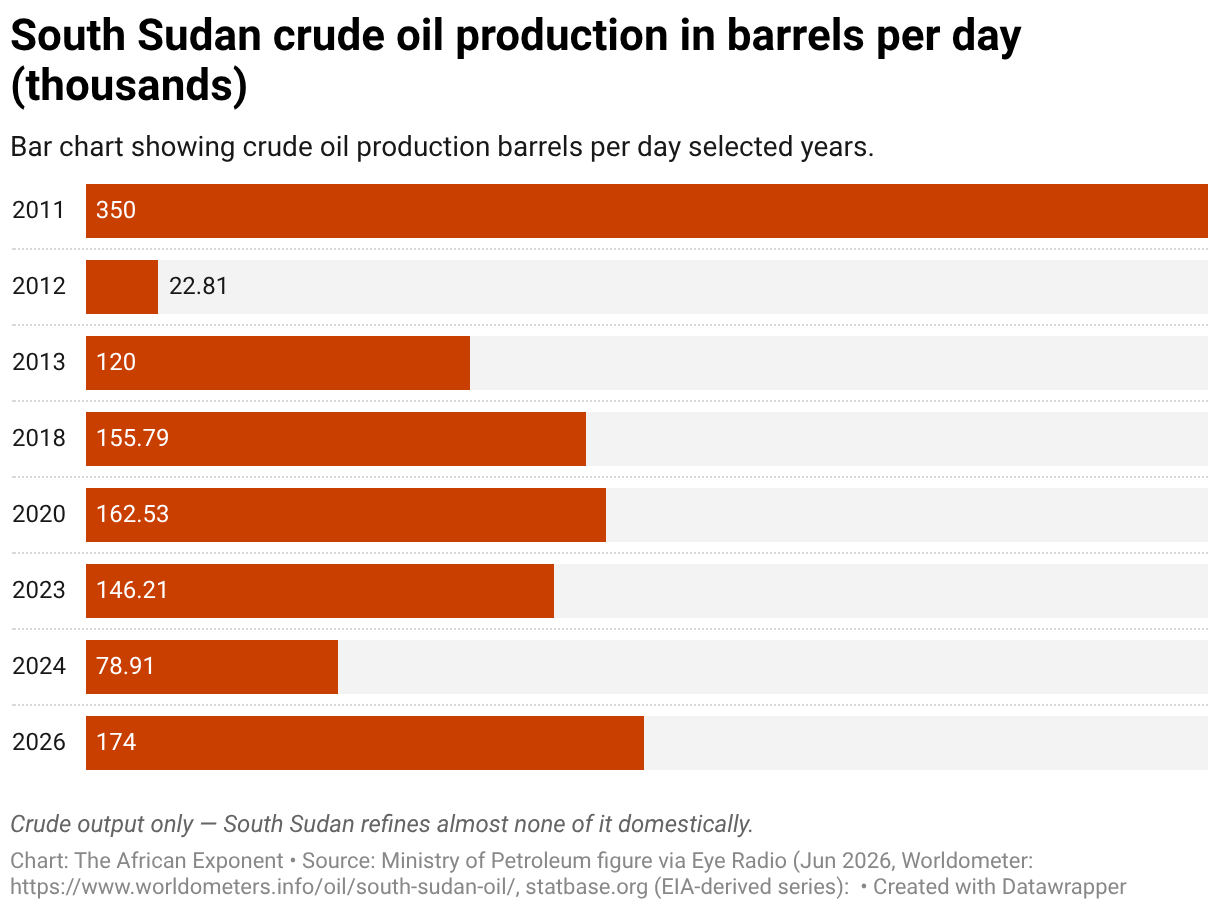
Observers have often misread South Sudan's downstream fuel market as a simple crude oil story. It is not. The country pumps plenty of crude, but it lacks almost everything necessary to turn that oil into reliable, affordable fuel, specifically refining capacity, storage, transport, and last-mile certainty. The Ministry of Petroleum reports that the country currently pumps about 174,000 barrels of crude oil daily. Production recovered strongly after a February 2024 pipeline rupture in war-torn Sudan slashed output below 80,000 barrels per day. This impressive volume makes South Sudan East Africa's largest crude producer, yet it hides a striking paradox: the nation imports almost all the refined fuel it needs.
Official data barely captures this heavy dependence. For instance, the Observatory of Economic Complexity tracked only $13.7 million in refined fuel imports for 2024. Meanwhile, Kenya exported about $220 million in goods to South Sudan that same year. Regional suppliers moved much of this value as re-exported fuel through the Mombasa corridor under government deals that public data often misses.
Since citizens and businesses consume roughly 12,000 barrels of fuel daily, the true annual import bill likely reaches hundreds of millions of dollars. This creates a massive financial drain, especially since the country holds almost zero domestic fuel storage. Therefore, investors and policymakers must look beyond the crude oil fields. Downstream facilities like depots, truck yards, and fuel terminals present the real challenge and opportunity. Ultimately, these local operations will secure or sabotage South Sudan's energy future.
Why does South Sudan import fuel despite producing so much oil?
South Sudan’s energy challenge involves deep structural gaps rather than temporary market cycles. When South Sudan gained independence in 2011, it inherited no major oil refineries because those facilities stayed north in Sudan. Today, the country relies on a single small refinery in Bentiu. Engineers designed this facility to process 10,000 barrels per day. However, repeated conflicts constantly disrupted its operations. Crews are still rehabilitating the plant, and it produces only a tiny fraction of its intended capacity which is nowhere near enough to satisfy the national demand.
The U.S. Energy Information Administration (EIA) notes that South Sudan depends entirely on imported petroleum to power its transport, electricity, and agriculture sectors. Meanwhile, officials have not set a clear timeline for building new refineries. Because of this domestic shortfall, imported fuel flows overwhelmingly through a single supply artery: the Mombasa–Juba route across Kenya and Uganda. The April 2023 civil war in neighboring Sudan severely damaged the Port Sudan corridor, which historically served as the second major inbound route. Therefore, every litre of diesel powering a Juba generator, a Wau water pump, or a truck on the Juba–Nimule highway, travels more than a thousand kilometers before reaching South Sudanese soil. The crude oil may be local, but the refined fuel is not.
What happens when fuel storage runs thin?
The impact of thin oil inventory goes beyond minor operational headaches and actively shapes the entire market. In markets with robust oil storage, buffer stocks easily absorb a two-week port disruption or a sudden spike in regional prices. In South Sudan, those same disruptions cascade immediately to the consumer at the pump. Because the country lacks significant storage capacity, it holds no meaningful strategic cushion against supply shocks.
Recent history shows the practical consequences of this shortfall. Seasonal flooding in 2021 and 2022 washed out sections of the northern road network and severed delivery routes for weeks. During the COVID-19 pandemic, mandatory testing at the Kenya–Uganda border created truck queues stretching for kilometers and squeezed fuel supplies all the way down the Northern Corridor. More recently, in April and May 2026, truckers formed a blockade at the Elegu border crossing after attackers killed a driver at an illegal roadblock on the Juba–Nimule highway. Within days, this protest triggered severe fuel shortages across much of the country. Furthermore, periodic insecurity along the Juba–Nimule and Bentiu corridors repeatedly forces transporters to reroute or halt operations entirely.
A market holding 30 to 60 days of reserve fuel would have quietly absorbed every one of these episodes. In South Sudan, each incident immediately drove up prices and dominated the news cycle. In this context, fuel storage operates as much more than a simple back-office utility. It represents the single most important lever for securing market stability.
Where will investors make returns?
Over the next decade, companies will build the most durable profit margins by controlling the physical infrastructure that stores and moves fuel, rather than by speculating on crude prices or pushing retail branding. Furthermore, fuel demand will only surge as the population expands, cities develop, and humanitarian needs increase. Smart capital will target concrete opportunities which will involve builders constructing storage tanks in Juba, Malakal, and Wau to hold 30 to 60 days of reserve fuel. Developers who position inland depots along the Mombasa corridor to shorten the last-mile haul will also find great opportunities. Logistics firms sizing trucking fleets to handle brutal wet-season roads and tech providers deploying digital systems that track inventory in real time are other opportunities to consider.
Additionally, suppliers can secure lucrative recurring revenue by fueling generator fleets for telecom towers, hospitals, and humanitarian groups, because these clients gladly pay a premium to prevent power outages. Savvy entrepreneurs can also sell corridor-risk solutions, providing insurance, security escorts, and route monitoring that keep trucks moving while competitors stall.
In South Sudan’s fuel case, physical supply trumps marketing and retail branding. It is the reason why there are no branded retail fuel stations. The country lacks the storage capacity in the first place therefore it means nothing without actual fuel in the tanks. Across the board, operators who guarantee delivery of fuel hold all the pricing power. Meanwhile, changing regulations are shaping the fuel import outlook. Since late 2025, Kenya and South Sudan have managed fuel imports through a government-to-government framework. Initially, officials channeled these imports through a single marketer, but they plan to open the market to additional suppliers in August 2026. This new licensing reality makes owning the underlying physical assets even more decisive. In a market where a single broken truck spikes pump prices, the company that owns the truck, the depot, and the tank captures the margin.