Table of Contents
Global hotel brands are rapidly transforming the Gombe district of Kinshasa. Marriott now displays its signs along the skyline. Radisson is building its first Congolese flagship nearby, and Grands Hôtels du Congo recently reopened La Tour, the newly revived 23-story high-rise tower of its premier Pullman Kinshasa Grand Hôtel.
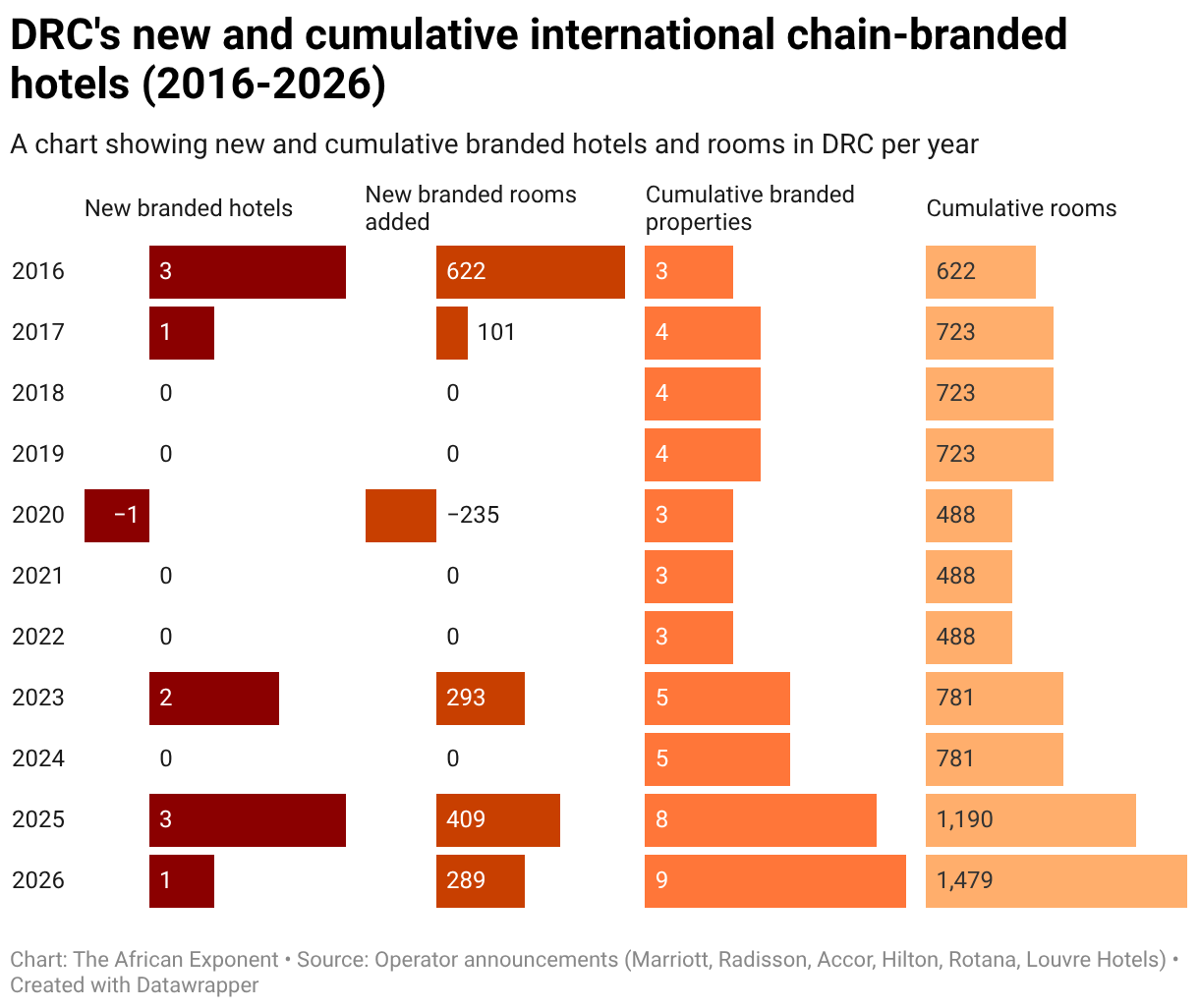
This cluster of luxury hotel brands feels surprising because the city welcomes only a few tourists every year and the country maintains a low GDP per capita below $700, for it to be a major market. Historically, developers built Africa's major hotel hubs along established vacation routes like Egypt, Morocco, and Mauritius, or in major business centres like Nairobi, Lagos, and Johannesburg. Kinshasa falls outside these traditional maps. Yet, the capital of the Democratic Republic of Congo (DRC) continues to add branded hotel rooms at a striking pace.
Investors are targeting a different market here by banking on steady demand from corporate travelers, diplomats, and institutions rather than vacationers. The early-2026 reopening of La Tour perfectly illustrates this strategy. This expansion gives the Pullman a lift of 369 rooms and suites, making it the largest hotel in the country. Predictable business travel now drives the DRC's hospitality market instead of unpredictable tourist cycles. This gives investors a much more reliable foundation for growth.
What does this new wave of branded hotels reveal?
Marriott’s December 2025 debut in Kinshasa sends the clearest signal. The US hospitality giant launched two properties on December 2, 2025: the 88-room Protea Hotel near the Congo River and the 134-room Four Points by Sheraton in the central business district. Marriott includes the DRC in a massive African expansion plan, aiming to add 50 hotels and 9,000 rooms by the end of 2027.
Radisson is aggressively expanding its footprint at the same time. The group signed its first DRC deal in 2025, scheduling the 110-room Radisson Blu Hotel Kinshasa to open in late 2026, while also securing future locations in Lubumbashi. Both operators rely on strict feasibility models. These major branded chains rarely invest money or sign management contracts unless they see a clear, five-to-ten-year pipeline of corporate account demand, government travel, and NGO traffic. They need strong proof that guests’ average daily rate (ADR) will consistently pay $150 to $200 per night and that occupancy will stay above 55 percent, regardless of political or economic cycles.
Therefore, these hotel openings matter precisely because they ignore the usual tourism playbook. Kinshasa attracts only a fraction of the vacationers that fill hotels in cities like Kigali or Dakar. Instead, investors see a different reality. Kinshasa is home to more than 17 million people and hosts a massive diplomatic, multilateral, and NGO community. The city also acts as the administrative nerve of a booming mining economy, which exported over $20 billion in cobalt, copper, and other minerals in 2023. This dynamic mix guarantees a steady stream of business travelers, international delegations, and contract workers. These are exactly the dependable guests that branded hotels need. Ultimately, Marriott’s arrival acts as a strong vote of confidence in the DRC’s corporate reliability, rather than its scenic charm.
Why is the state defending its stake in legacy assets?
A parallel move surrounding the state's premier hotel backs up this private-brand momentum. Grands Hôtels du Congo SA operates as a joint venture where the Congolese government and state agencies control 50 percent, while Belgian investor Victoria Equity owns the other half. Victoria Equity recently provided a $6.2 million loan to revive La Tour, the long-empty tower of the Grand Hôtel de Kinshasa. When the Belgian firm tried to convert this loan into equity, the Portfolio Ministry quickly secured $6 million from the national treasury in July 2025 to match the investment and prevent the state from losing its equal share. Because of this shared funding, La Tour was inaugurated in early 2026 under Accor's Pullman brand. The revival helped boost the hotel's capacity to an impressive 369 rooms and suites.
This financial maneuver matters for two major reasons. First, the government spent precious treasury funds to protect its ownership stake in a hotel, proving officials view premium hotel infrastructure as vital economic assets akin to airports or convention centres rather than regular real estate to sell off. Second, this joint investment highlights a shared confidence in the city's business travel market, with the Council of Ministers predicting the expanded property will double the company's total value. Neither the state nor private investors would risk millions if they doubted the steady flow of corporate and diplomatic guests. Ultimately, this strong local financial commitment sends a powerful green light to foreign operators eyeing the Congolese market.
Where do opportunities lie beyond hotel ownership?
This hotel boom sparks massive growth across the broader services economy. Multinational operators routinely outsource up to half of their operating costs, meaning local entrepreneurs can secure lucrative catering, laundry, and security contracts without ever owning a building. Furthermore, the MICE — meetings, incentives, conferences, and exhibitions sector offers another huge opening. As Kinshasa adds premium room stock, the city will finally gain the capacity to host regional mining summits, donor conferences, and sector forums. Local businesses will then capture the event logistics and translation demand that Johannesburg or Nairobi traditionally supplied.
Looking ahead, secondary cities represent the next medium-term frontier. Mining and trade hubs like Lubumbashi, Kolwezi, and Goma already attract more corporate travelers than their current hotel supplies can handle. (However, Goma's immediate future depends on the eastern DRC security situation, as ongoing conflicts delay stable business operations there). Where conditions permit, major brands already recognise this trend. For instance, Radisson is planning multiple properties in Lubumbashi alongside its Kinshasa flagship. Smart investors who build midscale hotels, serviced apartments, or conference centres in these smaller hubs will capture profitable demand long before international brands fully commit to them.
Ultimately, the DRC's hotel expansion ignores the traditional tourism narrative completely. Instead, it signals a thriving services economy where predictable corporate and institutional demand guarantees high occupancy rates. Marriott’s arrival, Radisson’s expansion, and the government's recapitalisation of Grands Hôtels du Congo all confirm that investors price Kinshasa as a serious business hub. Moving forward, savvy investors will find massive success by supplying the daily services, secondary-city accommodations, and operational infrastructure these massive properties need. The major brands just made the first move, and now local service providers stand ready to capture the next big wave of profits.