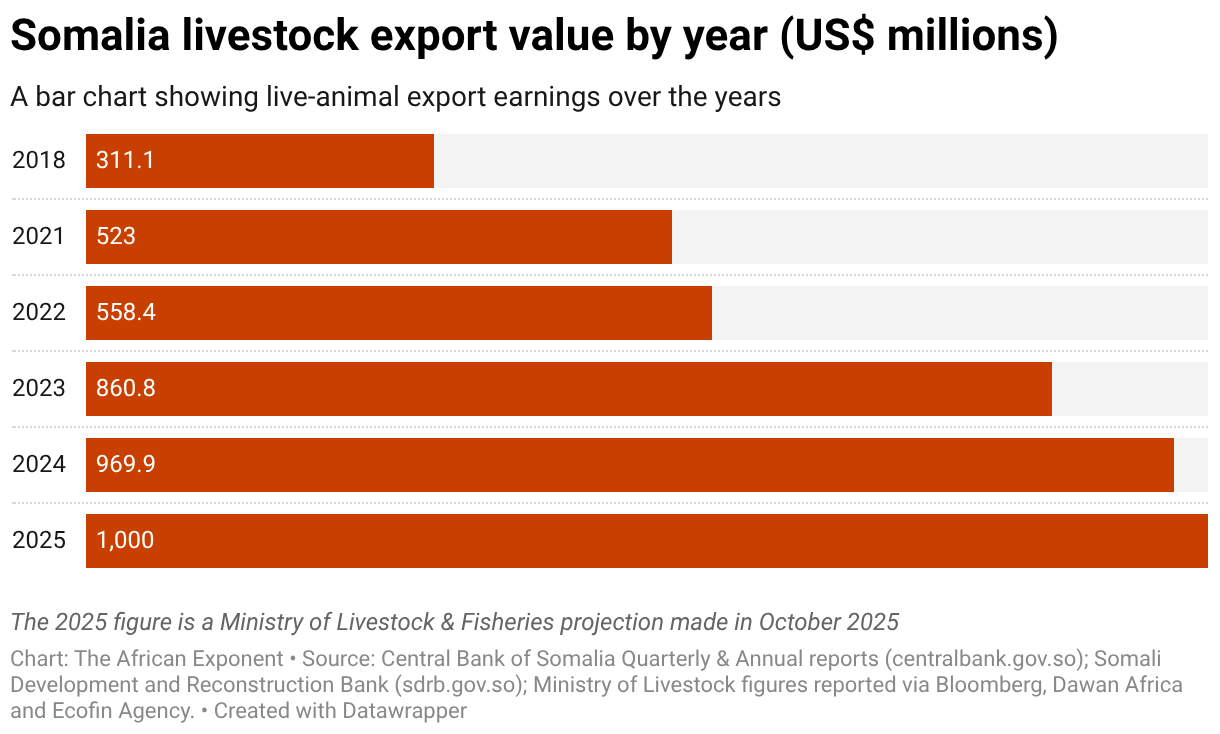
Many analysts have long treated Somalia's livestock trade as a pastoral survival economy, where traders shipped camels across the Gulf of Aden and trucked sheep to coastal cities for the Hajj season (the annual Islamic pilgrimage to Mecca, Saudi Arabia). Today, the data tells a much bigger story. Livestock export earnings nearly doubled in just three years, climbing from US$523 million in 2021 to a record US$970 million in 2024. Adding meat, hides, and skins pushes the sector's total export value to an estimated US$1.03 billion for 2024. This achievement marks the first time any Somali export industry has broken the billion-dollar barrier.
This milestone represents more than a temporary spike, as 2024 delivered a seventh consecutive year of steady growth. The industry carried this momentum right into the first quarter of 2025, generating 77 percent of Somalia's goods export earnings. The Ministry of Livestock even projects that live-animal sales alone will surpass US$1 billion, confirming the sector's transformation from a subsistence trade into a major industrial export engine.
How did Somalia's livestock exports break the billion-dollar ceiling?
In late 2016, Saudi Arabia, the industry's dominant buyer, banned Somali livestock imports over Rift Valley fever concerns. This kept the market largely closed for nearly six years with only brief reprieves in 2018 and 2020. Saudi Arabia finally lifted the ban in 2022, right as post-pandemic Hajj quotas returned to normal. Traders felt the impact immediately. Somalia's Ministry of Finance and Central Bank report that export values jumped 54 percent in 2023, growing from US$558.4 million to US$860.8 million as a result of the ban lift.
The industry then grew another 13 percent in 2024 to reach a record US$969.9 million. To hit this number, exporters shipped more than 6.4 million animals, including 5.9 million sheep and goats, 291,692 cattle, and 212,616 camels. This booming livestock trade drove a 54 percent surge in Somalia's overall goods exports that year and far outpaced any other sector. Traders carried this momentum into the first quarter of 2025, where shipments totaled 1.3 million animals and generated US$244.3 million. The Central Bank's Quarterly Economic Report notes this performance represents a 41 percent quarterly increase and a 4 percent year-over-year increase, accounting for 77 percent of all Somali export earnings.
The broader market structure also evolved during this growth period. Buyers in the Gulf, specifically Saudi Arabia, the UAE, Oman, Yemen, and Qatar, purchase roughly 90 percent of these exports. While the Hajj season still drives peak sales, the Central Bank notes that exporters are successfully finding buyers beyond the Gulf and securing orders year-round. Somali traders are also capturing market share from struggling rivals, stepping in for Sudan, where civil war crippled export corridors, and taking over for Australia, which plans to end live sheep sea exports by 2028. The expanding demand across the calendar and a wider pool of buyers separates a basic pastoral trade from a modern industrial export engine. The latest data clearly shows Somalia is making this profitable transition.
What does the true size of Somalia's herd economy reveal?
Beneath the headline numbers, you find a sector operating at a massive industrial scale. The Somali Development and Reconstruction Bank estimates the national herd reaches about 56 million animals, giving Somalia one of the largest livestock populations in Africa. Between 2018 and 2024, exporters shipped 31.5 million animals, with sheep and goats making up roughly 90 percent of that total. Over just the past five years, traders moved nearly 22 million animals to generate approximately US$3 billion in cumulative revenue.
The broader agriculture sector, driven almost entirely by livestock, generates about 65 percent of Somalia's GDP. Furthermore, livestock supplied 85 percent of the country's total goods exports in 2023, proving just how heavily the national economy relies on these animals for foreign exchange. Crucially, logistics companies now run the export corridor at an industrial level. DP World, the company that operates the Berbera terminal, and the Somaliland administration run a dedicated livestock facility that aims to process about 4 million animals each year. DP World reports that more than 4.1 million animals already pass through this port annually which creates a reliable commodity pipeline they value at over US$1 billion.
These impressive numbers change the entire economic conversation of the country. Somalia produces enough animals to meet global demand. The 56 million-head national herd easily supports the 6.4 million animals that traders currently export every year. However, the country urgently needs a domestic processing layer which includes modern slaughterhouses, health certification centres, and cold chain transport that keeps profits inside its borders. The question now is whether Somalia can capture more money from the value chain before these animals ever board a ship.
Where is the value-add pivot showing up in the data?
The Q1 2025 trade figures offer the first clear evidence that Somalia's pivot to added value is actually working. According to the Central Bank, meat exports nearly tripled, jumping from US$4.95 million in the previous quarter to US$13.7 million, while exporters simultaneously shipped 43 percent more hides and skins. To put this into perspective, Somali traders exported roughly US$16 million in fresh meat during the entire year of 2023, meaning a single quarter in 2025 almost matched a full year of previous sales. While these absolute numbers remain small, the growth trajectory tells an exciting story because processed products drastically outpaced the live-animal trade.
This 43 percent spike in hides and skins serves as a crucial secondary indicator. It proves that companies are slaughtering more animals onshore, which creates the essential foundation for a future leather-processing industry. Consequently, Somali operators can now capture the lucrative profit margins between wholesale live-animal prices and retail processed-meat prices. This was money that importers in Jeddah, Dubai, and Doha historically kept for themselves. This transformation is happening on the ground as well. Instead of just focusing on quarantine facilities, business leaders are now building modern cold-chain logistics networks and slaughterhouses that produce chilled meat to strict Gulf food-safety standards.
What must investors and operators build to capture the next billion?
Investors and operators face a clearly defined set of opportunities to capture the industry's next billion dollars. First, they must build health and quarantine infrastructure to protect revenue, since a single disease outbreak previously cost Somalia six years of Saudi market access. Because biological threats and disease suspensions can wipe out market access overnight, operators must view these quarantine investments as their core business insurance. Next, entrepreneurs need to develop export slaughterhouses and cold-chain logistics to capture the fast-growing processed meat segment highlighted in the recent trade data.
Financial institutions also have a massive opportunity to create formal trader finance, livestock insurance, and secure payment structures. Currently, this trade generates nearly one billion US dollars annually while relying entirely on informal credit. At the farm level, producers must invest in feedlots and fodder production to protect against drought-driven supply shocks and guarantee steady export volumes. Finally, logistics companies should expand port-side livestock terminals and welfare-compliant shipping to build upon the massive capacity that is currently operating at the Berbera port.
These asset classes offer solid business opportunities rather than speculative gambles. Each investment targets a specific bottleneck visible in recent trade data. Somalia already possesses an industrial-sized herd. The country simply needs a modern processing and compliance layer to keep profits onshore in order to generate the industry's next wave of wealth.