Table of Contents
Deep Dive!!
In the past two decades, Africa has experienced an unprecedented surge in trade and investment with China. From railways in Ethiopia to industrial parks in Kenya, Chinese companies are shaping the continent’s infrastructure and manufacturing landscape. But beyond bricks and steel, another revolution is quietly underway, Africa is increasingly using the Chinese yuan (RMB) in international trade, debt repayment, and reserves management.
This shift is more than a technical accounting change. It reflects Africa’s strategic attempt to reduce reliance on the U.S. dollar, mitigate currency risks, and integrate more closely with its largest trading partner. For policymakers, businesses, and investors, understanding how African countries use the yuan, who is adopting it, why, and what it means is critical.
Why the Yuan Is Gaining Ground in Africa
China is now Africa’s largest trading partner, with bilateral trade exceeding $260 billion in 2023 (CARI, 2023). For decades, these trade flows were dominated by the U.S. dollar. Importers in Africa would buy dollars to pay Chinese exporters, exposing themselves to currency fluctuations and high transaction fees.
The yuan offers an alternative. Using RMB for trade settlements and loans allows African countries to:
- Reduce Dollar Dependence: Avoids vulnerability to U.S. monetary policy or dollar volatility.
- Lower Transaction Costs: Settlements in yuan eliminate double conversion and related fees.
- Align Trade and Debt: Many Chinese infrastructure loans are denominated in RMB, so paying suppliers in yuan reduces currency mismatch risk.
- Access Liquidity: The People’s Bank of China has swap agreements with over 50 countries, allowing central banks to access RMB liquidity in times of need.
Country-Level Adoption
Kenya: A Model for Trade and Infrastructure Integration
Kenya’s embrace of the yuan is closely tied to Chinese-backed infrastructure. The Standard Gauge Railway (SGR), a flagship project connecting Nairobi to Mombasa and the Port of Mombasa, is financed largely through Chinese loans denominated in RMB. Payments to construction companies like China Road and Bridge Corporation (CRBC) are increasingly made directly in yuan.
The Central Bank of Kenya (2023) reports that Kenyan RMB reserves now exceed $500 million, allowing the government and private companies to settle trade without converting to dollars. Kenyan businesses importing machinery, electronics, and industrial inputs are opening RMB accounts in commercial banks, facilitating smoother trade and reducing currency risk.
This system also encourages financial sophistication. By managing RMB accounts, Kenyan firms learn to navigate foreign exchange markets beyond traditional dollar transactions, a skill increasingly relevant as Africa deepens ties with China.
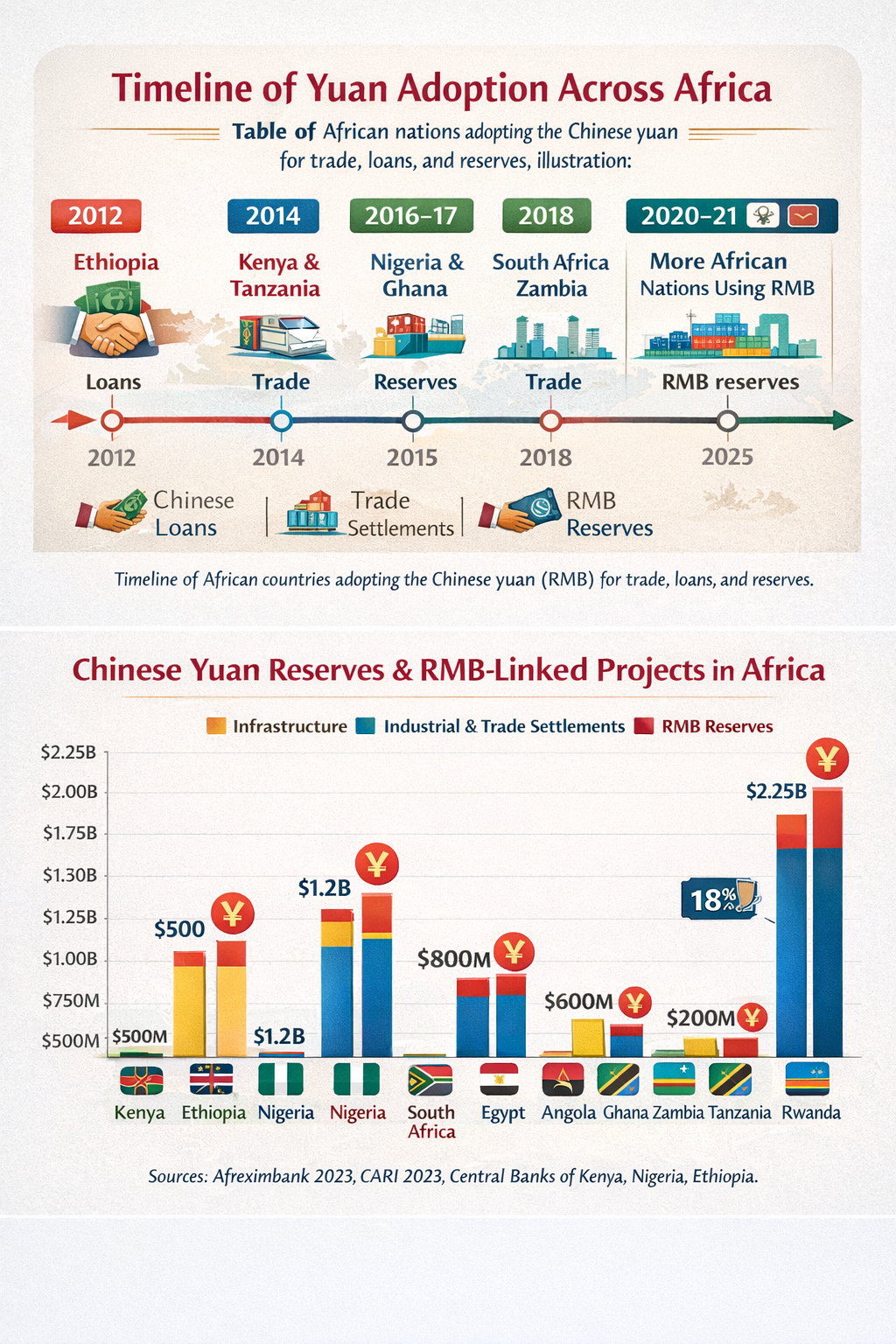
Comparison of Chinese yuan (RMB) reserves and project volumes across key African nations, highlighting the scale of adoption and financing
Ethiopia: Infrastructure Finance Meets Yuan
Ethiopia’s yuan adoption is perhaps the most illustrative example on the continent. Chinese-backed projects including the Addis Ababa–Djibouti Railway and industrial parks like Eastern Industry Zone are funded and partially serviced in RMB. According to CARI (2023), Ethiopia held $1.2 billion in RMB-denominated reserves as of 2015 to manage payments for Chinese construction and industrial contracts.
Chinese firms operating in Ethiopia, such as Huajian Shoes and Jiangsu Changlong Textile, also pay local workers and suppliers in yuan where feasible, streamlining financial flows. This integration ensures that the country’s infrastructure projects, trade settlements, and loan repayments are currency-coordinated, reducing exposure to the volatile dollar and stabilizing project budgets.
Nigeria: Trade and Debt Management
Nigeria, Africa’s largest economy, is gradually adopting the yuan in both trade and debt management. The Central Bank of Nigeria (2023) holds $2 billion in RMB reserves, primarily to pay for Chinese machinery, electronics, and industrial imports.
Major infrastructure projects, such as railway expansions and port upgrades by firms like China Civil Engineering Construction Corporation (CCECC), are increasingly settled in yuan. This approach reduces Nigeria’s reliance on scarce dollar reserves, aligns repayment with loan structures, and supports smoother bilateral trade.
South Africa: Industrial Trade in Yuan
South Africa, as Africa’s industrial hub, has also begun using RMB for trade. Companies importing Chinese industrial equipment, automotive parts, and electronics increasingly settle contracts in yuan. The IMF (2023) reports that South Africa’s RMB reserves increased by 18% between 2020 and 2023.
While still a smaller portion of total reserves compared to dollars, this gradual adoption signals a strategic hedge against dollar volatility and strengthens the country’s ability to negotiate terms with Chinese suppliers.
Egypt and Angola: Project-Specific Use
Egypt uses the yuan for large industrial and infrastructure projects, including the Suez Economic and Trade Cooperation Zones, funded through Chinese investment. Angola, heavily reliant on oil-backed Chinese loans, settles portions of debt and project payments in RMB.
According to Afreximbank (2023), Angola held $600 million in RMB reserves, which allows the country to service debt and import goods directly in yuan without resorting to dollars. These projects demonstrate that RMB adoption is often project-driven, closely linked to Chinese lending and investment.
Emerging Adopters: Ghana, Zambia, Tanzania, Rwanda
Other African nations are piloting RMB adoption, primarily for trade and loan servicing. Afreximbank facilitates RMB trade finance programs that allow these countries to pay for Chinese machinery, construction materials, and industrial goods directly in yuan. This reduces pressure on dollar reserves and simplifies trade operations.
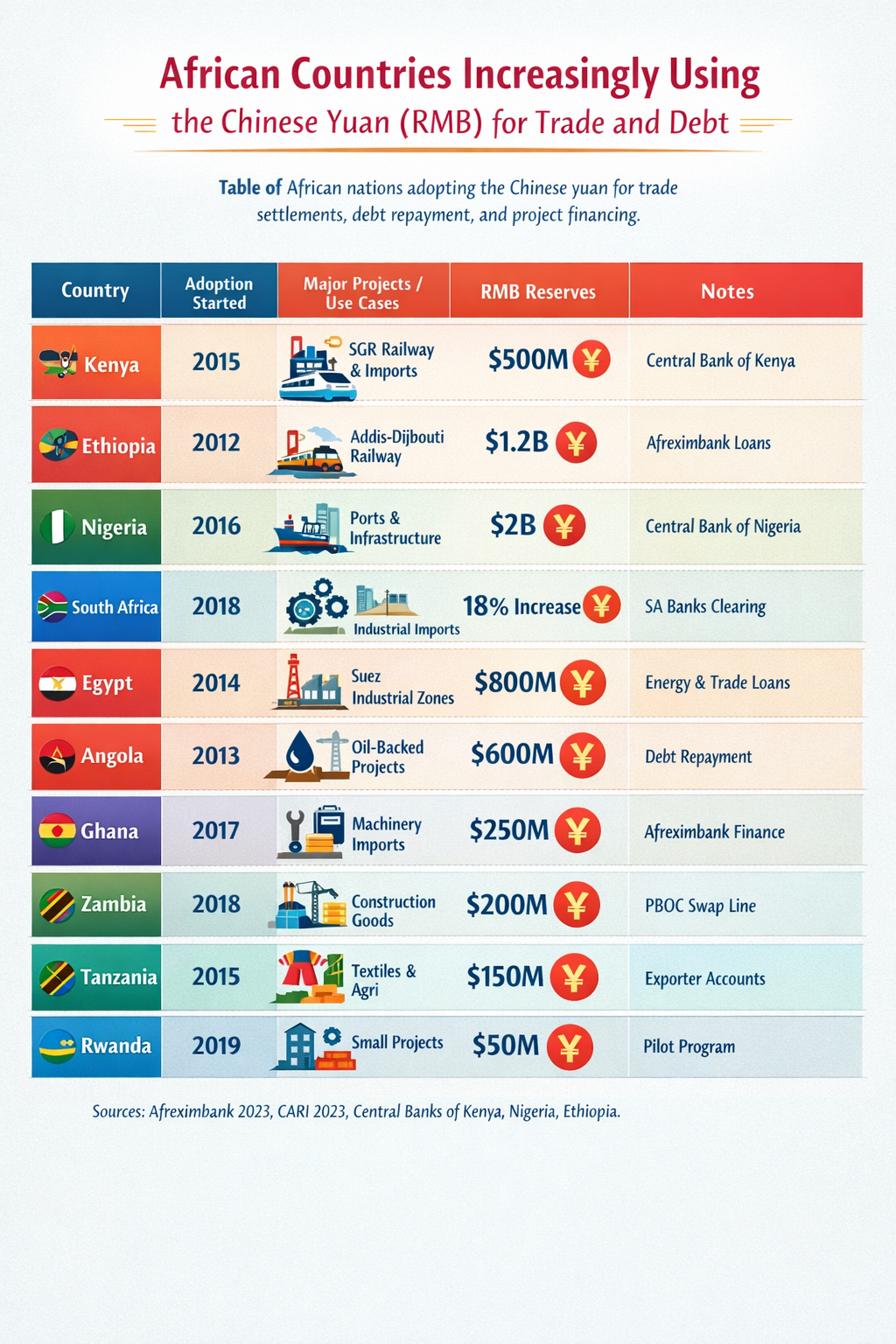
African countries increasingly using the Chinese yuan (RMB) for trade settlements, debt repayment, and project financing.
How Yuan Adoption Works
For those unfamiliar with international finance, the process can be broken down into four main mechanisms:
- Direct Trade Settlement: African importers pay Chinese exporters in RMB via banks holding yuan accounts, bypassing the dollar entirely.
- Debt Servicing: Some countries convert Chinese loans into RMB for repayment, aligning liabilities with incoming trade revenues.
- Central Bank Reserves: African central banks hold yuan to diversify foreign reserves and stabilize the national currency.
- Currency Swaps: Swap agreements with the PBOC provide temporary liquidity when RMB reserves are insufficient, enabling uninterrupted trade settlements.
Through these mechanisms, the yuan is not only a settlement currency but also a tool for strategic financial planning, reducing exposure to dollar fluctuations while supporting growth-oriented projects.
The Role of Global Yuan Hubs
Offshore yuan trading hubs are crucial for Africa:
- Hong Kong: The largest RMB hub, handling most of Africa-China FX settlements.
- Singapore & London: Provide major clearing and settlement services, enabling African banks to process yuan transactions efficiently.
- Luxembourg: A key hub for RMB-denominated securities in Europe.
These hubs ensure liquidity, timely settlements, and access to capital markets, making RMB adoption viable at scale.
Challenges and Considerations
Despite its advantages, RMB adoption is not without challenges:
- Currency Risk: The yuan fluctuates against local currencies and the dollar, impacting transaction costs.
- Regulatory Barriers: Some central banks impose limits on direct RMB use for trade or debt repayment.
- Limited Infrastructure: Not all African banks have robust RMB capabilities.
- Transparency Concerns: Some Chinese loans remain opaque, complicating public financial oversight.
Careful management is therefore essential to reap the benefits without introducing new fiscal vulnerabilities.
Looking Ahead
By 2030, the RMB is likely to become a key currency for African trade, finance, and debt management. Its adoption will expand through:
- Increased infrastructure and industrial financing from China
- Expansion of PBOC swap lines and trade finance programs
- Growth of private sector trade settlements
- Diversification strategies by African central banks seeking to reduce dollar dependence
The yuan is more than a currency; it is a tool reshaping Africa’s trade networks, debt strategy, and financial sovereignty. For countries like Kenya, Ethiopia, Nigeria, and Angola, RMB adoption is a calculated step toward integrating trade, debt, and development finance in a more resilient, multipolar world.