Table of Contents
Enrolment numbers have long defined the Democratic Republic of Congo’s education story. Today, that old narrative has changed. In April 2026, officials adopted the Kinshasa Declaration on education finance. As Actualité.cd reported, this agreement reveals that the DRC faces a structural funding gap of US$500 million to US$900 million every year. The state budget alone cannot cover this massive shortfall, but the specific financial target sends a clear procurement signal to the private market.
Beyond the numbers, policymakers have completely changed how they talk about learning. The Stratégie sectorielle intérimaire de l'éducation et de la formation (SSIEF) 2026–2030 framework no longer views education merely as a challenge of getting kids into classrooms. While officials still want to secure free primary schooling, they now prioritize educational quality, effective teaching, student employability, science, and innovation. They have deliberately pivoted their focus from basic inputs like building more schools and registering more students to real-world outputs.
They now ask what learners can actually do, whether teachers teach effectively, and if the system builds a capable workforce. For investors and private operators, this switch creates real opportunity. Businesses can measure, monetise, and build practical contracts around these tangible results much more easily than they can tackle broad, sweeping system reforms.
Why does the $500 million–$900 million financing gap signal a market shift?
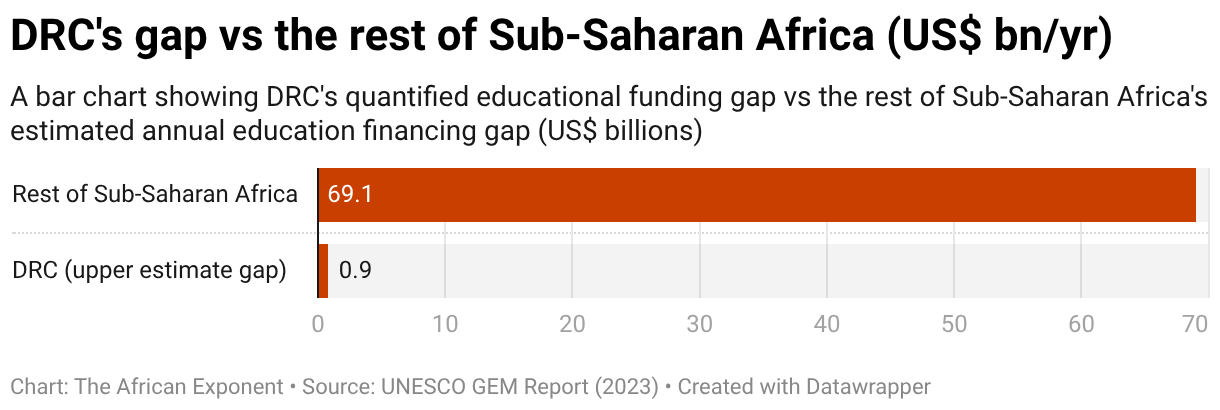
The massive funding gap in the Democratic Republic of the Congo (DRC) creates an immediate opportunity for private education partners. By early 2026, the government spent roughly US$650 million on its main education reforms. Even so, the system still requires hundreds of millions more annually than the state can actually raise. A broader view of this gap against the continental shortfall provides perspective for investors looking to invest in the country's education sector. UNESCO calculates that reaching global education goals (SDG4) across 79 developing nations requires US$461 billion every year through 2030. This leaves a yearly deficit of US$97 billion, with Sub-Saharan Africa shouldering the heaviest burden at US$70 billion. The DRC's specific need of US$500 million to US$900 million represents about 1.3 percent of Africa's total short fall. However, the DRC stands out because leaders used the Kinshasa Declaration to clearly measure this gap, build a supporting policy framework, and signal the opportunity to the market. Therefore, investors should treat this ongoing shortfall as a major open door for business.
The Kinshasa Declaration played a crucial role in this transition. When officials tie training outcomes directly to labour market needs, they effectively invite private providers to bridge the gap between basic schooling and real-world job readiness. The World Bank’s 2020 Human Capital Index highlights the urgency of this mission, giving the DRC a score of just 0.37. This sobering metric means a child born today will reach only 37 percent of their potential economic productivity. Consequently, smart investors treat the financing gap as a loud demand signal rather than a mere public-sector constraint.
Can the World Bank's US$500m digital package shift DRC's skills base?
A policy shift means nothing without the tools to make it happen. Fortunately, these delivery vehicles are arriving right now. Operating under the International Development Economics Association (IDEA) instrument, the World Bank's Digital Transformation Project delivers a US$400 million International Development Association (IDA) credit alongside €100 million in AFD co-financing. This combined package totals roughly US$500 million and targets the skills and connectivity layer of the education sector directly.
Project planners set concrete targets. World Bank documents show the initiative aims to reach 30 million beneficiaries, connect 1,000 public institutions to digital infrastructure, train 3,000 young Congolese in advanced digital skills, and upskill 1,000 secondary-school teachers. For private partners, each of these numbers represents a future contract, a new curriculum, a connectivity vendor, or a training operator.
A deep structural need justifies this massive investment. The World Bank’s own documents record a severely low digital-skills base in the DRC. They detail an education system that fails to meet labour-market needs and produces weak foundational skills across the student population. In other words, officials did not design this financial package on speculation. They built it to fix a measured, clearly documented deficit.
For the market, this means the government has already funded the first wave of customers. However, businesses must watch the timing. Officials approved the project in June 2024, and as of early 2026, the government, the World Bank, and the AFD still worked to put it into action. Now, key procurement processes finally move forward, including a lead consultancy tender that officials issued in May 2026. Therefore, a training provider that wins a contract to teach the 3,000-youth cohort does not have to bet on uncertain demand. Instead, that provider executes against a committed budget that already moves toward disbursement. This reality transforms education service delivery from a risky development gamble into a secure project-finance proposition. It offers a categorically different kind of opportunity, even though the cash flows will follow strict procurement schedules rather than broad policy announcements.
Where will private capital actually land?
Investors will not find equal rewards in every segment of the DRC's education market. Vocational and semi-formal training tied to telecoms, public services, logistics, and digital administration offers the clearest commercial angle. In these sectors, businesses can easily identify employer demand, certify specific skills, and price their curricula based on real outcomes rather than per seat.
Four related segments are forming around this core opportunity. First, private technical institutes can absorb the overflow from a public system that struggles to grow fast enough. Second, training providers can secure contracts to upskill the initial target of 1,000 teachers. More ambitiously, they can use this initial group as a stepping stone to reach the country's massive broader teacher base. Third, EdTech platforms that focus on job readiness rather than basic content delivery can plug directly into the new connectivity infrastructure that the World Bank project finances. Finally, school connectivity vendors can bid to link up the targeted 1,000 public institutions. For these vendors, each new connection creates a lucrative, recurring service relationship rather than a simple one-off sale.
A strict focus on measurable outcomes ties all these segments together. Today, donors release funding based on verified results rather than simple enrolment data. For example, the World Bank's free-schooling project paid its partners only when they met strictly audited, performance-linked indicators. Education providers will attract both public contracts and concessional capital if they can demonstrate high job placement rates, wage increases, or valid digital-skill certifications. Conversely, providers will fail to secure funding if they only show basic classroom attendance. Smart operators must design their business models around this exact dividing line from day one.
Smart operators must carefully price execution risk. Poor infrastructure, slow procurement cycles, and limited teacher capacity present real hurdles. Furthermore, the World Bank explicitly notes that students currently possess weak foundational skills. Early entrants will certainly absorb the initial friction costs of building new delivery rails from scratch. Yet, by taking this risk, these pioneers will set the exact standards that future government contracts will reference. That market influence represents the ultimate long-term prize.
Education in the DRC now stands as a major capital-allocation story. The state holds human-capital ambitions that public systems simply cannot deliver on their own.