Table of Contents
According to the Africa Visa Openness Index 2025, Rwanda is ranked the most visa‑open country in Africa, maintaining this position since 2023 because it allows visa‑free entry for all African nationals. That places it among a very small group of countries, including The Gambia, Benin, and Seychelles, that have removed visa requirements entirely for African travellers. Rwanda also holds a visa openness score of 1.000, the highest possible, compared to the African continental average of 0.445. This gap highlights just how far ahead Rwanda is in reducing entry barriers across the continent.
That difference shapes where activity happens. When Rwanda introduced visa‑free entry, leaders linked the decision to economic opportunity and making the country one of the easiest entry points for business, talent, and collaboration.
The question that follows is straightforward. If movement is easier in Rwanda than almost anywhere else on the continent, is that advantage translating into real economic outcomes?
How does Rwanda’s visa policy work, and why was it adopted?
Rwanda’s system removes the entry barrier entirely. Any African national may enter without a prior visa application, thereby eliminating both administrative steps and entry costs. This builds on earlier reforms. By 2016, Rwanda already allowed citizens of nearly 90% of African countries to obtain visas on arrival, reducing pre‑travel friction before removing it completely.
This progression reflects a broader trend identified in the Africa Visa Openness Reports between 2016 and 2025, where several African countries moved from restrictive visa regimes toward visa-on-arrival systems, and in fewer cases, full visa-free access. Rwanda’s transition from visa-on-arrival coverage in 2016 to full visa-free access by 2023 places it among a small group of countries that have implemented continent-wide mobility policies.
That shift followed measurable outcomes. Earlier openness policies were associated with a 50% increase in cross‑border trade with neighbouring countries, showing that reducing travel barriers directly affects economic activity.
The policy also sits inside a broader structure. Rwanda’s Visa Openness is part of an administrative and investment policy framework designed to attract and retain business activity. Other measures to this end include Rwanda permitting full foreign ownership and free capital movement, along with the Rwanda Development Board coordinating investment through a centralized system designed to reduce the time required for establishment. In this context, visa openness is not a standalone reform but one of several aligned measures aimed at making market entry, business setup, and expansion easier for both African and global investors.
You can see the effect in sectors that depend on movement. Rwanda hosted 115 international conferences in 2024, and Kigali was ranked 2nd in Africa for hosting international association meetings according to ICCA 2024 rankings, showing that the city is gaining prominence as a regional business hub. These events rely on predictable access; without it, they move elsewhere. Rwanda removes that uncertainty at the entry point.
Is Rwanda’s visa openness actually changing its business and investment landscape?
The investment data shows movement. In 2024, Rwanda recorded USD 3.2 billion in investment commitments, up from USD 2.4 billion in 2023, a 32.4% increase in one year. That growth reflects rising interest across multiple sectors, including manufacturing, finance, and real estate. This investment is expected to create over 51,600 jobs, showing a direct socioeconomic impact of Rwanda’s policies.
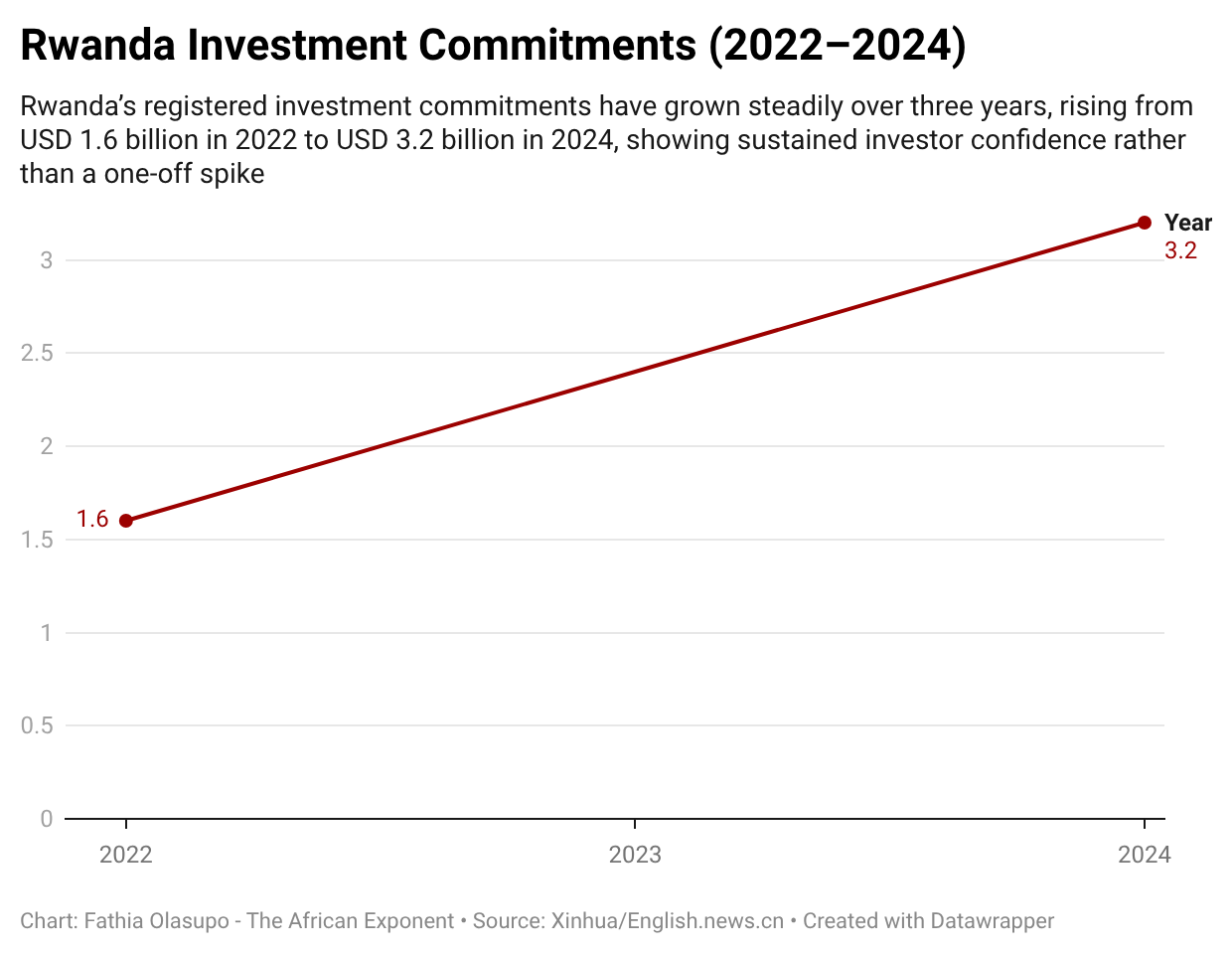
The source of that investment is also shifting. In 2024, Nigeria, Eritrea, and Ethiopia contributed over USD 464 million in FDI into Rwanda, with Nigeria alone accounting for USD 313 million. This rise in intra-African investment is a key indicator when assessing whether Kigali’s business ecosystem is changing. While direct data on founder nationality or firm ownership composition is limited, the growing share of regional capital suggests that more African investors are entering, operating, and scaling businesses within Rwanda.
This pattern also aligns with findings across Africa Visa Openness Reports, which consistently show that countries reducing visa restrictions tend to experience increased cross-border movement and business interaction over time. Rwanda’s experience reflects this broader trend, where improved mobility appears to coincide with rising investment flows and stronger regional engagement.
Mobility and travel-dependent sectors make this shift more visible. The conference economy is scaling quickly, providing a clear signal of business activity linked to movement. The MICE sector generated USD 84.8 million in 2024, supported by over 52,000 delegates. Conference-related hotel occupancy in Kigali averaged 78% in 2024, up from 63% in 2023. Over a longer period, this growth becomes more pronounced, rising from USD 37 million in 2015 to USD 85 million in 2024, with projections reaching USD 130 million in 2025 and USD 224 million by 2028.
Taken together, these indicators suggest a gradual shift in Kigali’s business ecosystem. Increased conference activity, higher volumes of regional investment, and sustained business travel all point to a city that is becoming more integrated into intra-African commercial networks, even if detailed firm-level composition data is still emerging.
Tourism data reinforces the same pattern. Rwanda recorded 1.36 million visitors and USD 647 million in tourism revenue in 2024, with business travel and conferences playing key roles. Notably, a majority of these visitors come from within Africa, with estimates suggesting that over half, and in some cases up to 70% of arrivals, originate from neighboring countries. Over 1.09 million of these visitors came from the East African Community (EAC), meaning that roughly 80% of arrivals were regional, highlighting the extent to which visa-free access is driving intra-African mobility. Gorilla tourism revenue alone increased by 27%, contributing over USD 200 million to the total.
At the same time, the relationship between visa openness and exports requires clearer framing. Visa-free access does not directly increase exports, but it lowers barriers for investors, entrepreneurs, and partners to enter the country. These actors can establish businesses, build supply chains, and form partnerships that later translate into outward trade. In this sense, inward mobility supports export growth over time rather than causing it immediately.
Is Rwanda’s open‑door model more effective than selective approaches like Mauritius?
Rwanda’s model is not the only approach. Mauritius provides a useful point of comparison, but a meaningful comparison depends on outcomes, not just policy design.
Rwanda’s strategy is built around mobility-dependent sectors. Its rapid growth in conference hosting, rising volumes of regional investment, and increasing business travel all point to an economy that benefits directly from the movement of people. Kigali’s emergence as a conference and business hub reflects this alignment between visa openness and sector focus.
Mauritius, by contrast, operates a more selective visa system but performs strongly in different areas. It remains a leading financial hub, attracting investment through legal, tax, and financial structuring advantages rather than high volumes of physical business traffic. This means that while both countries attract capital, they do so through different mechanisms.
The difference becomes clearer when looking at how each model supports economic activity. Rwanda’s conference industry has scaled rapidly, with Kigali ranking among Africa’s leading cities for international meetings, supported by steady growth in events and delegates. The Rwanda Development Board also supported over 240 local companies to expand into new markets in 2024, generating USD 164.1 million in additional export revenues. Here, visa openness plays a supporting role by making it easier for international partners and clients to engage with Rwandan firms, which can then scale into export markets, rather than directly driving exports itself.
Rather than one model being universally more effective, the evidence suggests that each approach works best when aligned with a country’s economic structure. Rwanda’s open-door policy strengthens sectors that depend on movement, while Mauritius’ selective model supports capital-intensive and financial services sectors.
How should investors interpret visa openness when evaluating a market?
Visa openness works when it connects to execution. On its own, it does not create investment. Some countries have increased visa-free access but saw modest investment growth. Ghana, for example, has maintained relatively open entry policies while experiencing fluctuating FDI tied more to macroeconomic conditions than mobility. This highlights that openness alone isn’t enough without a strong business infrastructure.
Rwanda does because the policy aligns with outcomes. Investment is rising, conferences are expanding, and intra‑African capital is becoming more visible. These are all sectors where movement matters.
At the same time, comparisons with other markets show that visa openness is not a standalone advantage. Capital can still flow in more controlled systems if legal and financial structures are strong.
So, visa openness should be read as a signal. It signals that a country is reducing friction for people. What matters is whether that reduction connects to systems that allow businesses to operate, scale, and move capital efficiently.
In Rwanda’s case, that connection is becoming more visible. Entry is unrestricted, investment shows sustained growth rather than short-term spikes, regional capital is increasing, and sectors tied to physical presence, such as conferences and business travel, are expanding. While some aspects of Kigali’s business ecosystem, such as firm ownership composition, are still difficult to quantify directly, the available indicators suggest that the policy is contributing to a more regionally integrated and accessible market.