Table of Contents
In Summary
- American exports to the continent are increasingly concentrated in high-value machinery, aircraft components, energy systems, and medical technologies rather than consumer goods as of 2026.
- Coastal access, industrial depth, and infrastructure investment continue to determine which African economies dominate U.S. goods imports.
- The composition of imports reveals where productive capacity is expanding on the continent and where dependency on external capital goods remains strongest.
Deep Dive!!
Monday,29 January 2026, the trade relationship between Africa and the United States reflects a structural shift that has been quietly unfolding for more than two decades. In the early 2000s, U.S. exports to Africa were largely dominated by food commodities such as wheat, rice substitutes, and basic manufactured goods aimed at household consumption. Today, customs and export data show a very different picture. American goods entering African markets are increasingly tied to production, infrastructure, energy, aviation, and healthcare.
This evolution is driven by both supply and demand dynamics. On the African side, rapid urbanization, industries are not yet able to supply at scale. On the U.S. side, exports to Africa are increasingly concentrated in sectors where American firms maintain strong competitive advantages, including aerospace, energy equipment, medical devices, and advanced machinery.
The ranking below is based on the total value of U.S. goods imported and cleared through African customs, measured in U.S. dollars. While the most recent fully consolidated data comes from 2024, trade volumes, port activity, and sectoral demand trends extending through 2025 and into early 2026 indicate continuity in both ranking and import composition. A clear pattern emerges across the data. Countries with established ports, industrial clusters, and energy or aviation infrastructure consistently account for the largest share of U.S. imports, reinforcing the dominance of coastal and industrialized economies in trans-Atlantic trade.
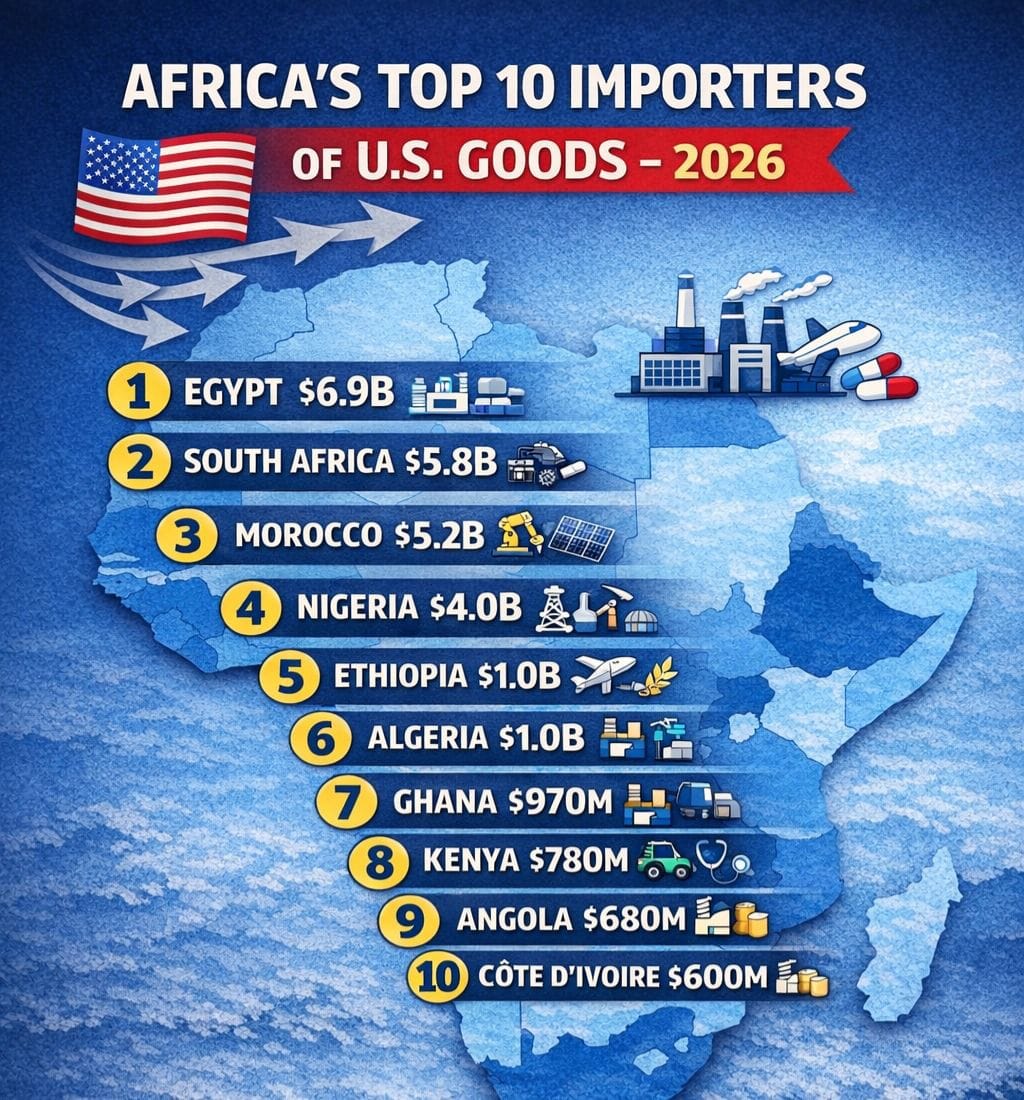
Leading African countries importing U.S. machinery, energy equipment, vehicles, and industrial goods in 2026.
10.Côte d’Ivoire
As of 2026, Côte d’Ivoire imports an estimated US$600 million worth of goods from the United States annually. Two decades ago, the country’s imports from the U.S. were heavily concentrated in agricultural commodities, particularly wheat and other food inputs required to support urban consumption.
Industrial machinery represents 35%, including cocoa-processing grinders, roasting equipment, automated packaging lines, and quality-control technology for Abidjan’s agro-processing clusters. Electrical infrastructure medium-voltage transformers, industrial refrigeration systems, and cold-storage units accounts for 20%, while medical devices, diagnostic imaging machines, sterilizers and patient monitors total USD 75 million. Construction materials such as cement mixers and steel reinforcement bars make up 10% of imports.
Comparatively, EU exports totaled USD 425 million, India USD 235 million, and Turkey USD 190 million, highlighting the U.S. scale advantage. Côte d’Ivoire’s reliance on American industrial inputs enables agro-processing modernization but introduces long-term dependency risk and limits domestic machinery production.
9. Angola
Angola’s imports from the United States stand at approximately US$680 million per year as of 2026, shaped primarily by the oil and gas sector. In earlier years, U.S. exports to Angola were relatively limited and focused on vehicles, spare parts, and basic industrial equipment. As oil fields matured and operational complexity increased, demand shifted toward specialized capital goods.
Current specialized drilling machinery, subsea compressors, pipeline control systems, and industrial pumps account for 40% of imports. Construction equipment for port and road rehabilitation represents 20%, electrical generators and transport machinery 15%, and medical equipment, laboratory analyzers, hospital beds, imaging machines-USD 60 million.
EU exports were USD 360 million, India USD 215 million, and Turkey USD 120 million. While alternatives provide partial mitigation, U.S. machinery remains critical to Angola’s energy infrastructure, highlighting concentrated reliance and potential long-term vulnerability.
8. Kenya
Kenya imported USD 9.4 billion, a 22% increase over 2025. Industrial and construction machinery dominates at 38%: road pavers, concrete mixers, industrial generators, port logistics systems, and water-treatment machinery support Nairobi and Mombasa infrastructure projects. Electrical and telecom equipment including fiber-optic cables, industrial switchgear, and telecom towers represents 15%, while medical imports MRI and CT scanners, dialysis units, hospital monitoring systems total USD 400 million. Agro-processing machinery for tea, coffee, and grain milling and cold-storage facilities accounts for 12%.
EU exports were USD 875 million, India USD 425 million, and Turkey USD 210 million. The U.S. dominates in scale and technology for high-value industrial and medical equipment. Kenya’s dependency risk is moderated by alternative suppliers, but American exports remain central to industrial modernization and healthcare expansion.
7. Ghana
As of 2026, Ghana imports close to US$970 million in goods from the United States each year. In the early 2000s, trade was anchored in food imports and basic machinery used for consumption and small-scale production. Over time, Ghana’s industrial ambitions reshaped its import profile. Industrial machinery and vehicles account for 40%, supporting industrial parks, light manufacturing, and construction projects. Renewable energy equipment, including solar panels and storage systems, comprises 15%. Medical imports-MRI machines, surgical tools, laboratory reagents total USD 155 million, reflecting the growth of specialized healthcare.
EU exports were USD 725 million, India USD 325 million, and Turkey USD 210 million. While China also plays a role in Ghanaian industrialization, the U.S. remains the leading supplier of high-technology industrial and healthcare equipment. Reliance on imports poses long-term industrial dependency risks, though diversification through alternative partners offers partial mitigation
.6. Algeria
Algeria imports approximately US$1.0 billion worth of U.S. goods annually as of 2026. Earlier import patterns included a wider mix of consumer goods and standard industrial equipment. Sustained public investment and energy-sector requirements have since reshaped demand.
Energy-related machinery like turbines, generators, hydraulic systems, and power-distribution technology makes up 40% of imports, while construction machinery for housing and transport projects accounts for 20%. Industrial chemicals and specialized tools total 10%, and medical equipment, hospital diagnostic devices, surgical systems, and laboratory analyzers-USD 165 million (+24% YoY).
EU exports were USD 875 million, India USD 375 million, and Turkey USD 210 million. U.S. machinery drives Algeria’s energy modernization, but high dependency poses strategic and financial risks, particularly as large-scale infrastructure projects remain credit-dependent.
5. Ethiopia
Ethiopia imported USD 1.0 billion, +18% YoY. Aviation and transport machinery like aircraft engines, avionics, landing gear components make up 30%, while industrial machinery for textiles, leather processing, and food production accounts for 35%. Construction materials and energy equipment such as generators, substation components represent 15%, and medical equipment including diagnostic imaging, patient monitors, and lab analyzers-USD 120 million. EU exports totaled USD 375 million, India USD 210 million, and Turkey USD 125 million. Ethiopia’s reliance on U.S. exports supports aviation, industrial, and healthcare expansion, with partial diversification through alternative partners.
4. Nigeria
Nigeria imports more than US$4.0 billion worth of U.S. goods annually as of 2026, placing it among the continent’s largest importers. Historically, imports from the United States were modest relative to oil exports and focused on vehicles, refined fuel, and basic equipment. Recent years have seen a shift toward capital-intensive imports.
Energy-sector equipment dominates, including drilling systems, compressors, pipeline infrastructure, and power-generation components. Heavy construction machinery supports transport and housing projects, while medical equipment such as imaging systems, laboratory instruments, and pharmaceuticals addresses healthcare gaps. Wheat remains a major import due to domestic production shortfalls. Nigeria’s import profile highlights strong industrial demand alongside persistent dependence on foreign capital goods.
3. Morocco
Morocco imports approximately US$5.2 billion worth of U.S. goods annually as of 2026, reflecting deep integration into global manufacturing value chains. Earlier imports focused on agricultural commodities and basic machinery. Industrial policy has since reshaped demand.
Advanced manufacturing machinery, including CNC machines, robotics, and precision tools, supports automotive and aerospace clusters. Aircraft components and electrical systems feed export-oriented factories, while soybeans and animal feed support agribusiness. Renewable energy equipment also features prominently as Morocco expands solar and wind capacity. U.S. imports play a central role in Morocco’s industrial competitiveness.
Moroccan imports now focus on industrial equipment for automotive and aeronautical industries, construction machinery, and high-performance textile fabrics for industrial and fashion sectors. Medical imports include hospital imaging devices, diagnostic laboratory equipment, and surgical tools. Customs data shows these imports have risen consistently since 2014, reflecting Morocco’s industrial diversification strategy and healthcare modernization.
2. South Africa
South Africa imported an estimated US$17.3 billion in U.S. goods in 2026, making it a major gateway for high-value products in Southern Africa. Historically, imports focused on consumer electronics and automotive parts, but recent trends show a shift toward industrial and energy equipment. Customs records reveal that South Africa imported gas turbines, hydraulic pumps, industrial generators, and electrical transformers to support mining, energy production, and infrastructure projects. In textiles, U.S. fabrics, primarily high-quality cotton blends and performance textiles used in both fashion and industrial uniforms-account for a notable portion. The country also imported diagnostic medical devices including CT and MRI scanners, automated laboratory analyzers, and hospital-grade surgical kits, reflecting investments in healthcare infrastructure. These imports, largely concentrated since 2015, have increased sharply due to industrial modernization and urban expansion.
1. Egypt
Egypt stands as Africa’s largest importer of U.S. goods as of 2026, with imports estimated at US$6.9 billion annually, with a strong focus on industrial machinery, energy equipment, and advanced medical devices. U.S. turbines, generators, and water treatment machinery supply the country’s growing energy and industrial sectors. Textiles include high-grade cotton and synthetic blends used for local garment industries. Diagnostic equipment imports, such as MRI and X-ray machines, automated clinical analyzers, and surgical kits, have expanded in response to healthcare reforms. These imports have accelerated since 2010, supporting Egypt’s industrial zones, export-oriented manufacturing clusters, and hospital modernization programs.
Machinery for power generation, water treatment, and industrial manufacturing dominates, while aircraft parts and aerospace systems support the aviation sector.
Why This Matters
U.S.-Africa trade data reveals where African economies have built real export capacity and where dependence on a narrow range of commodities persists. Countries exporting manufactured goods and processed products show greater resilience to policy shifts and demand cycles. Those reliant on energy or raw commodities remain exposed to price swings and external shocks.
What the Rankings Reveal About Africa in 2026
Africa’s largest exporters to the United States are not simply those with resources, but those with ports, processing capacity, and long-standing trade integration. The concentration of exports among a handful of countries highlights both progress and imbalance. While some economies have embedded themselves deeply into U.S. supply chains, many others remain marginal participants.
As global trade becomes more competitive and selective, the countries that continue to expand exports will be those that move beyond extraction into processing, manufacturing, and reliability. In 2026, U.S.–Africa trade is less about volume alone and more about capability, consistency, and strategic positioning.
Conclusion
By 2026, U.S.-Africa trade is no longer defined by food shipments alone. It is shaped by machinery, aviation, energy systems, and medical technology that underpin economic transformation. The concentration of imports among a small group of African economies highlights both opportunity and imbalance. Where imports are integrated into industrial strategy, they accelerate growth. Where they remain disconnected, they deepen dependency. The next chapter of U.S.–Africa trade will be written not by volume alone, but by how effectively these imports are turned into lasting productive capacity.