Table of Contents
In Summary:
- Many African strategy games predate the earliest documented forms of chess by centuries or millennia.
- Mancala variants dominate the list, reflecting Africa’s deep tradition of mathematical and strategic play.
- Archaeological finds and oral histories confirm games were tools for education, leadership, and diplomacy.
- The ranking reasserts Africa’s central role in the global history of strategy and intellectual culture.
Deep Dive!!
Thursday, 22 January, 2026 – Africa’s intellectual history is often underrepresented in global narratives of strategic thought, yet the continent has produced some of the world’s oldest and most sophisticated games. Long before chess emerged and spread beyond Asia and Europe, African societies developed complex board and strategy games that trained memory, foresight, mathematics, and diplomacy. These games were embedded in daily life, leadership training, trade culture, and spiritual practice, reflecting deep traditions of logic and competitive reasoning.
Drawing on archaeological evidence, ethnographic records, and academic research from museums and cultural historians, this article highlights African countries whose indigenous games predate or rival early forms of chess. By ranking these countries from 10 to 1, the article repositions Africa as a foundational contributor to global gaming history and strategic thinking, rather than a passive recipient of imported intellectual traditions.
10. Morocco — Sīdī boughrī and Regional Mancala Variants
In Morocco, traditional mancala variants such as Sīdī boughrī have been played for centuries. These games involve moving seeds or stones across pits in strategic patterns, teaching players to think ahead and anticipate opponents’ actions. Mancala games are documented throughout North Africa and are believed to have ancient origins linked to early human settlements in the region.
Historical records and comparative linguistics suggest North African mancala games predate the spread of chess into the region in the medieval period, affirming Morocco’s place in the history of cerebral play. Many variations in Morocco reflect local cultural values, with games played at markets, social gatherings, and inter-village competitions.
Today, these games remain part of cultural heritage projects and community celebrations, illustrating how strategic thinking embedded in daily life predates global games like chess.
9. Tunisia — Mancala and Rites of Strategy
Tunisia shares in the North African legacy of mancala, locally known as awale or langa, with historical roots tracing back over a thousand years. Archaeological indications and ethnographic research point to mancala’s widespread use in ancient Carthaginian and Berber communities.
Mancala boards often served dual functions: entertainment and social education in counting, foresight, and competition. The game’s patterns and rules vary across villages, with some variants considered direct precursors to similar African games found further south.
In Tunisia today, these ancient games are preserved through cultural festivals, youth teaching programs, and academic initiatives that document their historic depth relative to early forms of chess.
8. Mali — Mancala and Strategy Games of the Niger Bend
Mali’s rich history around the Niger River includes a long tradition of wari, one of the oldest known mancala games in West Africa. Records and oral traditions suggest wari has been played for centuries, making it even older than the earliest European references to chess.
The game features strategic seed distribution and capture, and is especially popular among communities in the Niger Bend, where trading networks helped spread the game across the region. Ethnologists note that wari and related games were used for teaching arithmetic, planning skills, and competitive interaction long before formal schooling systems arrived.
Mali’s role in preserving wari reflects a broader commitment to intangible cultural heritage, with wari frequently featured in museum exhibitions and inter-community tournaments that celebrate its longevity.
7. Burkina Faso — Luba and Traditional Board Strategy Games
In Burkina Faso, indigenous strategy games such as luba and other mancala variants are deeply embedded in community life. Local traditions hold that these games were part of social learning processes in pre-colonial kingdoms, used to teach negotiation, forward planning, and resource management.
Anthropological research shows these games often feature boards carved from wood or dug pits on the ground, underscoring their historical antiquity. Oral history suggests that many of these games existed long before external games like chess entered the region.
The continued practice of these games in rural and urban centers alike makes Burkina Faso a key cultural repository for ancient strategic play.
6. Nigeria — Ayo Olopon and Other Indigenous Strategy Games
Nigeria’s Ayo Olopon (also known as Awele or Oware in other regions) is one of the best documented mancala variants in West Africa. Historical accounts suggest that Ayo Olopon and its cousins were being played in Yoruba, Edo, and Igbo communities long before the arrival of chess through European or Islamic diffusion.
The game’s complexity and enduring popularity reflect deep cognitive training embedded in culture, and scholars consider Ayo Olopon an integral part of Nigeria’s rich intellectual traditions. These games are still played in marketplaces, town squares, and cultural festivals, preserving links to ancient social learning and competitive skill.
Nigeria’s role in the dissemination of Ayo Olopon across the diaspora underscores its cultural significance and historical depth.
5. Ghana — Oware and Akan Strategy Tradition
Among Ghana’s Akan communities, Oware is a classic ancestral game that is deeply integrated into social life and cultural storytelling. Archaeological and ethnohistorical evidence places Oware’s use centuries before documented instances of early chess in the Mediterranean.
Oware’s sophisticated rules require strategic thought, symbolizing wisdom, patience, and decision-making, qualities celebrated in Akan proverbs and leadership structures. The game circulated widely through trade routes, contributing to its spread across West Africa and the Caribbean.
In contemporary Ghana, Oware is taught in schools, played in competitions, and used as a cultural touchstone, showing how ancient games surpass modern introductions like chess in historical relevance.
4. Senegal — Warri and Sahelian Strategic Play
Senegalese communities have long played Warri and related board strategy games, passed down through generations as part of familial and community bonding. These games involve tactics and long-term planning, skills central to leadership and negotiation in traditional societies.
Ethnographic studies place these games as well established prior to the introduction of chess, emphasizing Africa’s parallel history of cerebral strategic arts. Warri boards have been found in contexts that suggest deep heritage, particularly in Sahelian and coastal settlements engaged in early trade and cultural exchange.
Senegal’s festivals and educational programs now celebrate these games as cultural heritage, showcasing their complexity and age relative to global war games like chess.
3. Ethiopia — Gebeta and Royal Strategy Tradition
Ethiopia’s Gebeta is a mancala variant played across ethnic communities and historically within royal courts. Oral traditions and cultural historians note that such games were ingrained in social interaction and courtly entertainment long before chess became a global phenomenon.
Gebeta’s presence in historical literature and museum archives reveals how strategic vision and mathematical logic were valued cultural tools. Ethiopian regnal chronicles and travellers’ accounts speak to the game’s role in both leisure and strategic conversation.
The durability of Gebeta across centuries highlights Ethiopia’s place in Africa’s intellectual history and its contributions to strategic game culture predating widespread chess influence.
2. Sudan — Senet and Ancient Nubian Strategic Play
Sudan’s Nile Valley history overlaps with ancient Nubian and Kushite civilizations. Game boards and stones found at archaeological sites around Merowe and the Nile reflect strategic play traditions comparable to early Egyptian Senet, which predates classic chess by millennia.
Although Senet itself is Egyptian in origin, the region’s ancient strategic games reflect exchanges between Nubian and Egyptian cultures, embedding strategy play within daily ritual and spiritual life long before chess’s medieval emergence.
These ancient board games served not only as leisure but as training in foresight, balance, and planning, skills valued by warrior and trade classes alike.
1. Egypt — Ancient Senet and Strategic Play Older Than Chess
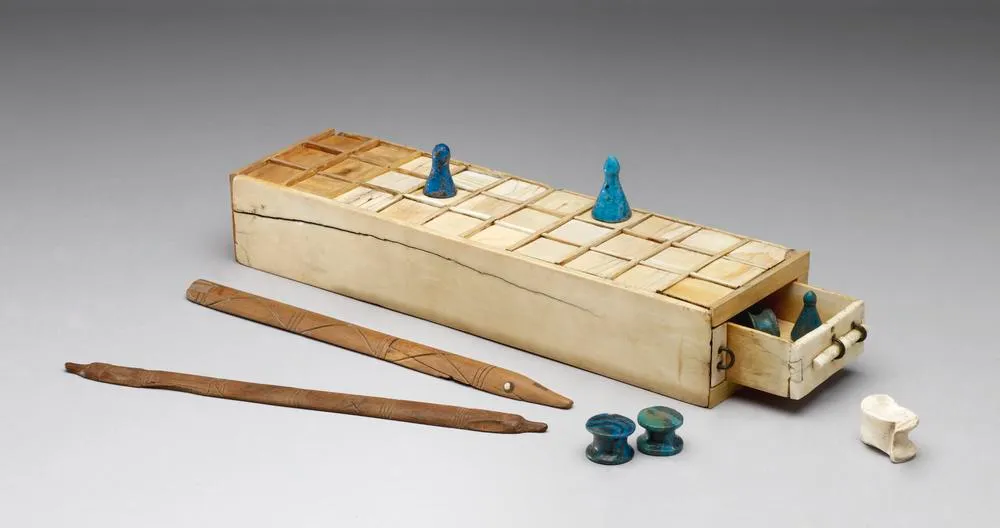
Topping this ranking is Egypt, whose ancient game Senet is one of the oldest known board games in human history, dating back over 5,000 years. Senet boards and pieces have been found in tombs from the First Dynasty onward, making it significantly older than any known form of chess. (Wheels, Canada Museum of Civilization)
Senet involved strategic movement of pieces, some ritual elements, and cognitive engagement that scholars interpret as both game and spiritual metaphors. The game was often depicted in tomb art and royal iconography, underscoring its cultural resonance across millennia.
Egyptian strategic games shaped the conceptual landscape of play and planning, influencing subsequent board games across Africa and beyond. For this reason, Egypt’s heritage of indigenous games stands as the oldest and most influential in this ranking.
We welcome your feedback. Kindly direct any comments or observations regarding this article to our Editor-in-Chief at [email protected], with a copy to [email protected].