Table of Contents
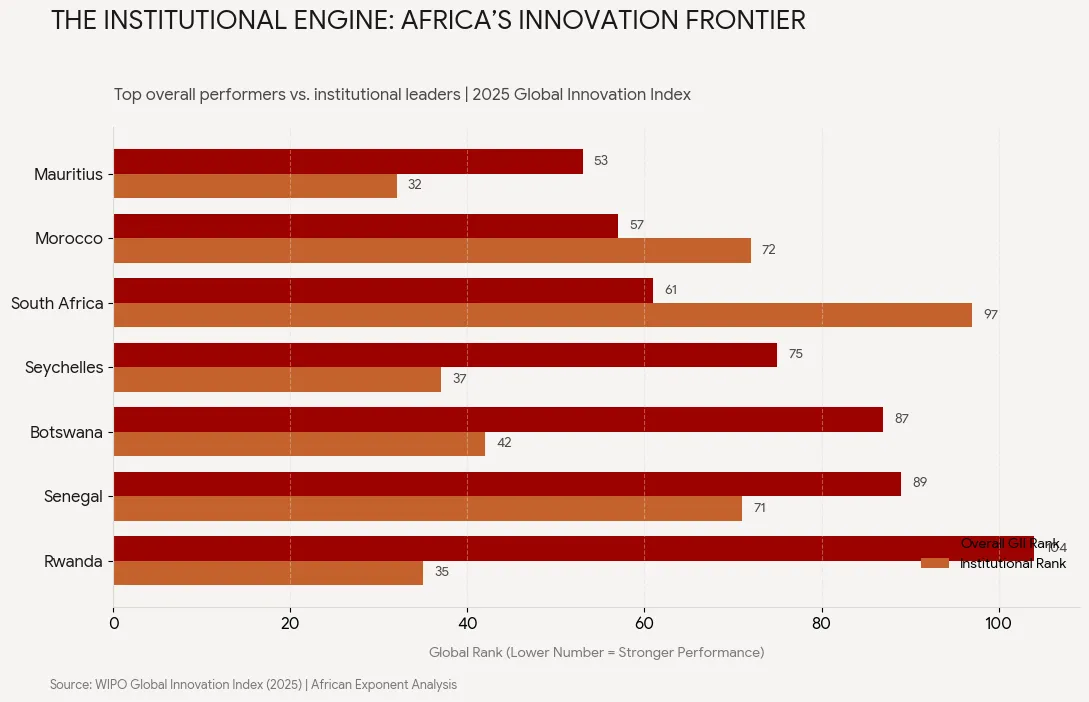
The 2025 Global Innovation Index (GII) reveals that the continent’s top-performing economies are those that have prioritized stable, sophisticated national institutions over mere infrastructure spending. Mauritius, Morocco, and South Africa lead Africa by successfully bridging the gap between high-level policy and tangible technical results. This transformation aligns with our Geopolitics and Market Intelligence pillars, as institutional scores act as a critical proxy for "internal friction." Investors use these rankings to calculate "country risk" and "compliance overhead," and the data proves that while financial investment is necessary, a country’s regulatory environment remains the most reliable predictor of its global innovation standing. Together, these leaders represent the "innovation frontier" for Africa, consistently outperforming their peers in both foundational support and actual results.
Who are the Current Leaders in Innovation?
The 2025 rankings identify a clear tier of leaders: Mauritius (53rd), Morocco (57th), and South Africa (61st). These are the only three nations on the continent to break into the global top 65. Mauritius stands out as the regional benchmark, particularly in its legal and business environment, where it ranks 32nd and 28th globally. Morocco follows with a strong emphasis on creative products, while South Africa maintains a competitive edge through its sophisticated business sector. Together, these three countries represent the "Innovation Frontier" for Africa, consistently outperforming their peers in both foundational support and actual results.
What Explains the Success of these Top Nations?
The success of these leaders is driven by the Institutional Pillar, which acts as the "operating system" for a national economy. Unlike nations that focus solely on physical projects, these leaders have modernized their Regulatory Environments and Business Frameworks.
For example, Mauritius and South Africa have established high scores in Rule of Law and Government Effectiveness, which reduces the risk for private investors and tech startups. This stability allows national agencies to move beyond basic oversight and provide specialized technical support. In these environments, "Innovation Inputs" such as easy access to credit and intellectual property protection are efficiently converted into "Outputs" like high-tech exports and digital services. Essentially, these nations have built a "Gold Standard" regulatory engine that allows every dollar invested in research to produce a higher return in economic value.
What Does this Mean for Future Growth Across Africa?
The current data suggests that climbing the Global Innovation Index is a result of smart planning rather than just the size of an economy. For nations looking to match this success, the evidence shows that strengthening the power and skills of national agencies is the most effective path forward. As these three leaders continue to improve their business environments, they are setting a standard for the rest of the continent. The lesson is clear: the nations building the strongest foundations today are the ones that will lead Africa's digital and creative economies of tomorrow.