Table of Contents
With a population of over 240 million people, a US$ 400 billion-plus economy, and a dominant position in West African trade, Nigeria continues to attract capital into sectors such as energy, telecoms, and financial services. Yet beneath this opportunity lies a persistent security challenge that directly shapes investor risk assessments in the country.
In recent years, Nigeria’s military spending and budget allocation have declined, and this shift is already visible in practical terms. Oil majors and indigenous producers have faced persistent losses from crude theft, pushing companies like Shell and ExxonMobil to divest onshore assets in favour of more secure offshore operations. In March 2025, Shell finalized the $1.3 billion sale of SPDC to the Renaissance consortium after years of theft-driven spills, while in October 2024, the Nigerian government approved ExxonMobil’s $1.28 billion sale to Seplat Energy, reinforcing its shift toward a $10 billion offshore-focused strategy.
In the logistics sector, transport operators moving goods between northern and southern Nigeria increasingly factor in security escorts and informal payments, thereby raising costs and delivery times. Even in urban centers like Lagos, private firms are expanding spending on private security infrastructure to compensate for gaps in public enforcement.
For investors, the implication is clear: Nigeria’s risk profile is no longer defined solely by the presence of insecurity, but by the state’s declining fiscal capacity to contain it. As public security provision weakens in real terms, the burden of risk mitigation is gradually shifting to the private sector.
How Nigeria’s Security is Structurally Underfunded?
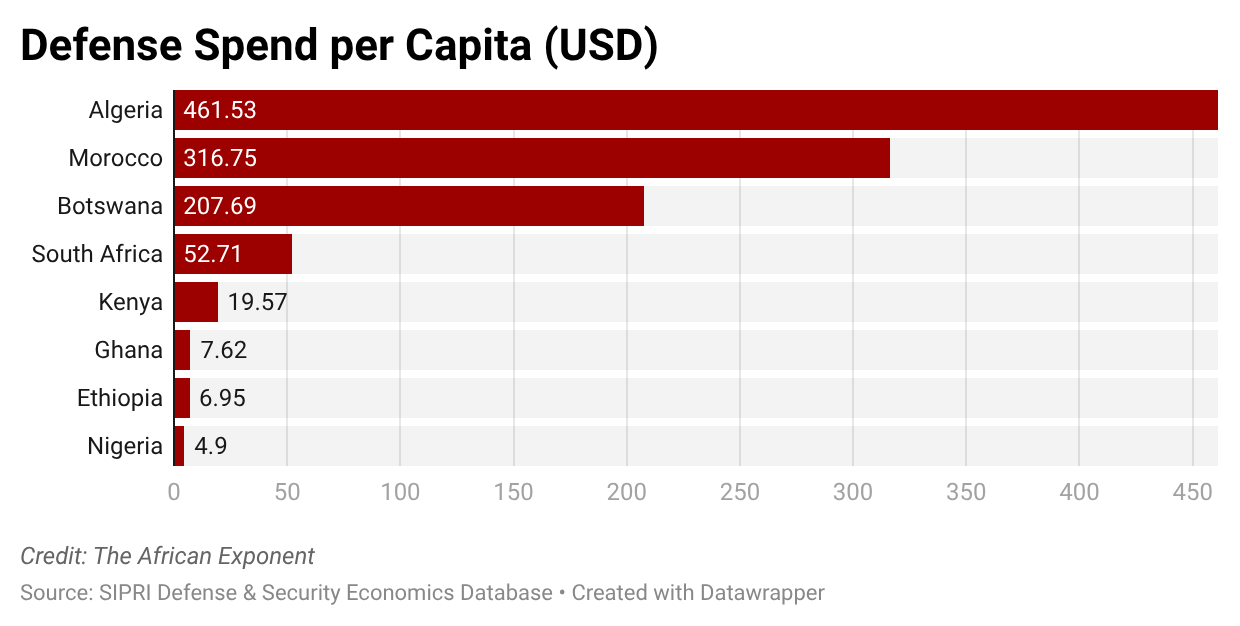
To understand why the Nigerian state is struggling to secure its borders, it is necessary to examine the country's per capita investment in defense. In 2024, Nigeria spent just $4.90 per citizen on defense, which is laughable considering that Kenya spent $22 per capita and Ethiopia spent $7.10. Even Ghana, which faces a significantly more stable domestic environment, outspent Nigeria at $7.90 per person. When a country facing simultaneous insurgencies, separatist movements, and industrial-scale oil theft spends less than $5 per person on its military, the result is not just a tactical deficit; it is a structural failure of the investment case for public safety.
According to data from the SIPRI Defense & Security Economics Database, Nigeria’s military spending in 2024 fell from US$2.06 billion in 2019 to US$1.99 billion in 2024. This represents a 3.4% real decline over five years. Despite the removal of petrol subsidies in 2023, which theoretically freed up fiscal space, the 2024 and 2025 budgets indicate that extra funds have been consumed by debt servicing and personnel costs rather than being reallocated to defense. Nigeria’s defense share of government expenditure sits at roughly 3.1%, significantly lower than Ethiopia (6.9%) and Kenya (4.4%).
Is There a Fiscal Constraint to Nigeria’s Low Defense Funding?
The roots of Nigeria’s defence underspending lie in its fiscal structure. For years, petrol subsidies and debt servicing absorbed between 30% and 50% of government expenditure, crowding out capital-intensive sectors like defence. The assumption was that removing subsidies in 2023 under President Bola Tinubu would free up fiscal space for priority spending, including security. In a July 7, 2025 address, the President said “Since [subsidy] removal, we have redirected those funds into targeted interventions, expanding our social safety nets…..These efforts go beyond mere economic metrics. They are building economic resilience, and strengthening our national security.”
However, the data suggests otherwise. According to the Stockholm International Peace Research Institute (SIPRI), Nigeria’s military spending continued to decline in real terms to $1.99 billion in 2024, even after subsidy removal. This indicates that the expected reallocation toward defence has not materialized.
Instead, fiscal relief has been offset by rising debt servicing obligations and inflation. As borrowing costs increase and the naira weakens, a larger share of government revenue is redirected toward interest payments rather than capital expenditure. In effect, subsidy savings have been absorbed by macroeconomic pressures rather than redeployed into security.
This is a critical inflection point. If subsidy removal did not lead to a rebound in defence spending, then the constraint is not cyclical but structural. Unlike peers such as Ethiopia, which allocates a larger share of its budget to security as a foundation for economic activity, Nigeria’s spending patterns suggest that defence remains fiscally subordinated.
Is a Private Market Filling the State’s Vacuum?
As state capacity weakens, a parallel market has expanded rapidly. Nigeria’s private security industry now protects assets worth an estimated $218 billion, covering the majority of non-oil economic activity.
The sector employs a “silent workforce” of over 1 million people, according to the Nigeria Security and Civil Defence Corps, making it one of the largest in Africa. Established firms such as Halogen Group, Vanni International, and Sheriff Deputies dominate traditional security services, while newer players like Terrahaptix are pushing into AI-driven surveillance and drone technology.
Demand is also shifting. While oil and gas remain the anchor client, sectors like agribusiness and financial services, which account for nearly 30% of security expenditure, are rapidly increasing security spending as they expand into higher-risk regions. The fastest-growing segment is tech-enabled security, led by companies like Terrahaptix. Using AI-driven drones and surveillance systems, they secure large, high-risk assets such as pipelines and farmland, helping the Nigerian defence technology startup to secure US $34 million in seed capital in 2026 alone, raising its valuation to over US $100.
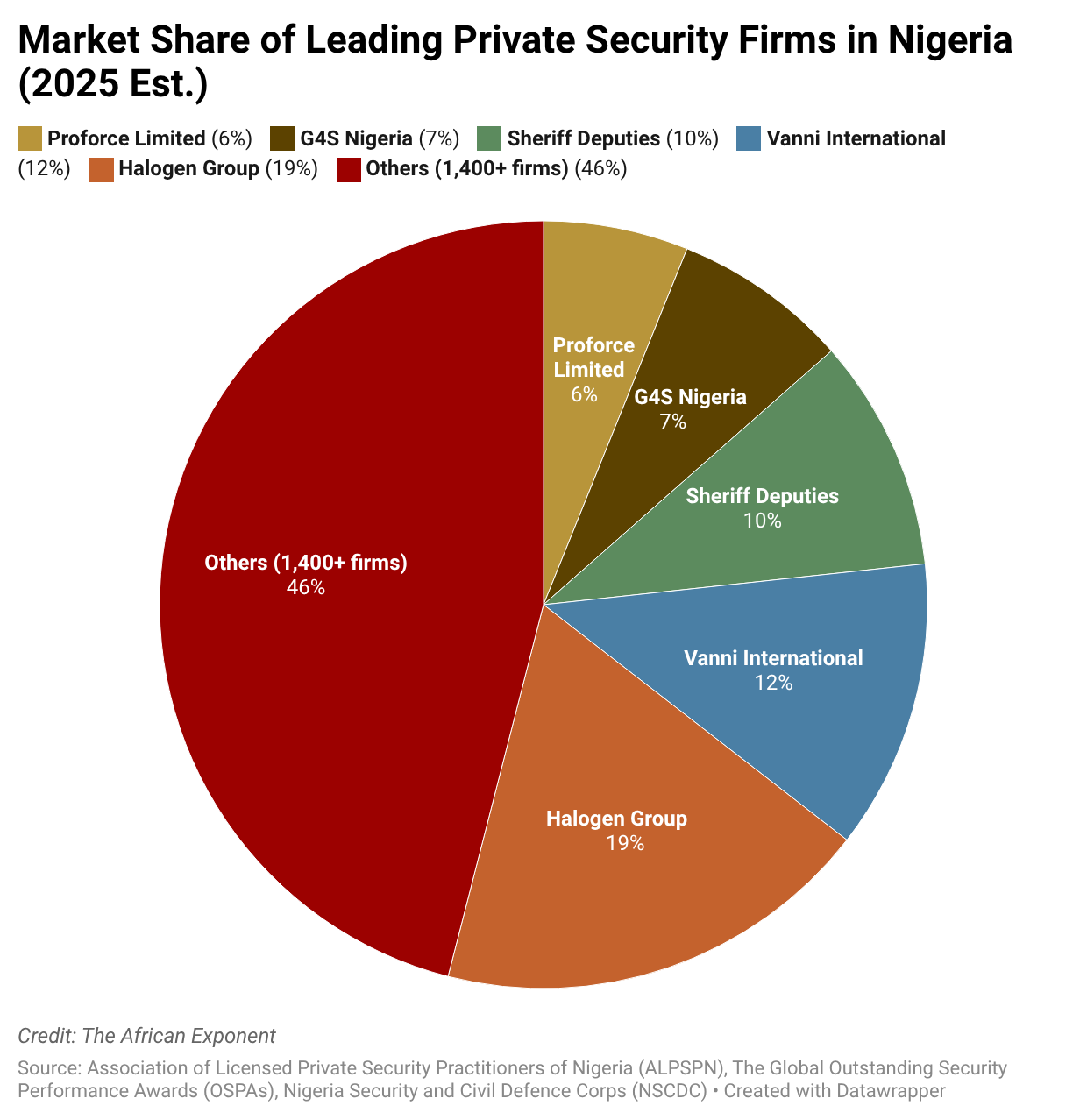
Across all segments, the model is consistent: private firms are monetizing risk through guard contracts, service retainers, and surveillance platforms. Nigeria’s security gap has therefore created not just a cost burden, but a parallel industry that is becoming central to the country’s investment landscape.
Does Geography Dictate the Limits of Nigeria’s Security Spending?
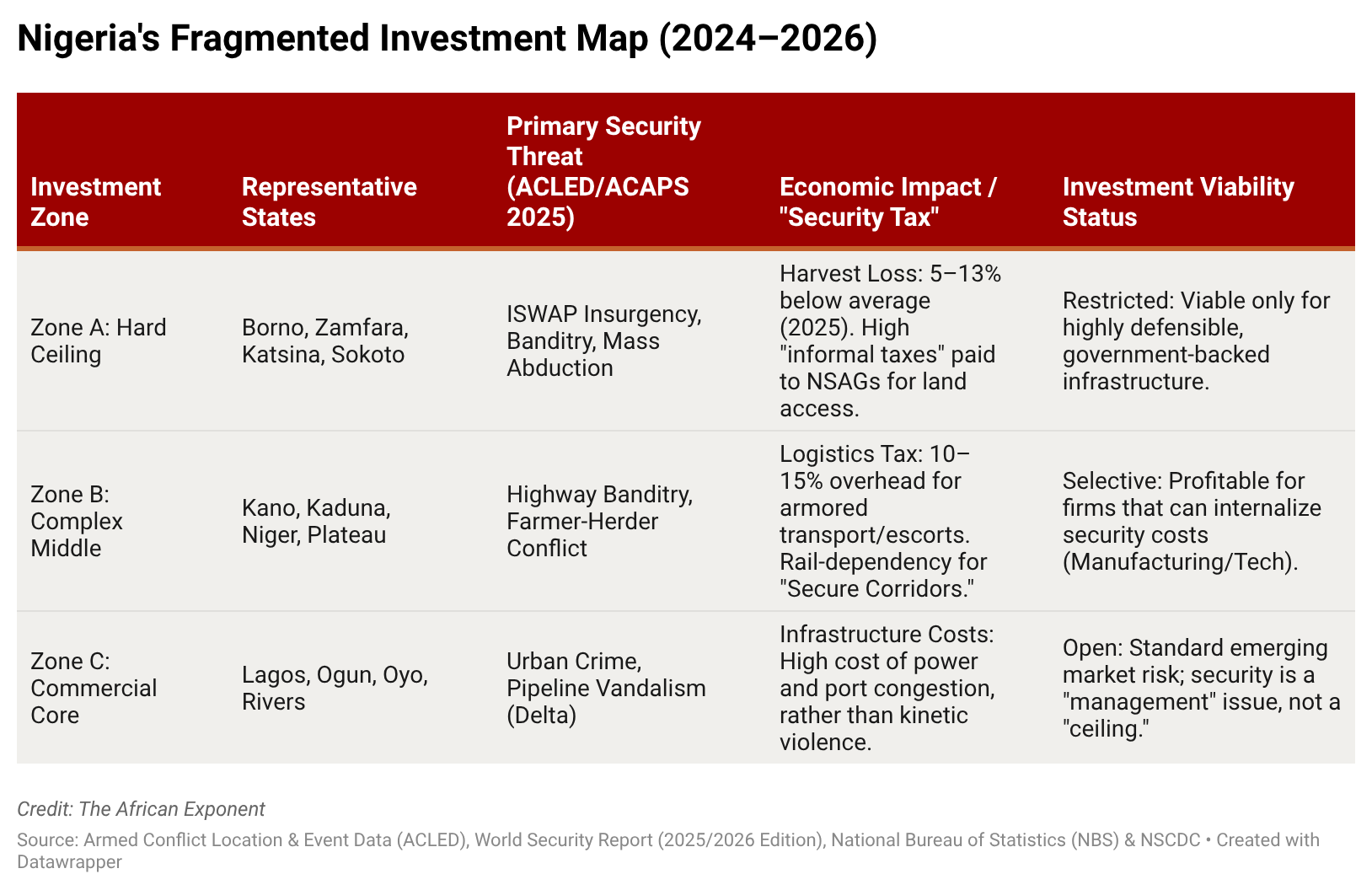
Security spending in Nigeria is not uniform. In states such as Borno State, Zamfara State, and Katsina State, insecurity acts as a hard ceiling on investment. Data from the Armed Conflict Location & Event Data Project (ACLED) shows that agricultural activity has declined significantly in parts of the northwest, with farmers abandoning land due to persistent violence.
In contrast, cities like Kano and Kaduna represent a more complex middle ground. Manufacturing continues in Kano, but firms operate with a “security tax,” often spending 10–15% more on logistics and protection than comparable businesses in Lagos. Kaduna’s services and tech sectors remain active but depend heavily on secure transport corridors.
The result is a fragmented investment map where project viability depends as much on security architecture as on market fundamentals.
What do Kenya and Ethiopia Achieve from Higher Military Spending?
The contrast with East Africa illustrates what Nigeria is missing. In Kenya, sustained defence spending supports secure export corridors, enabling a $1 billion floriculture industry centered around Lake Naivasha. Reliable security allows international investors to commit long-term capital with confidence.
Ethiopia offers a similar case. Its coordinated security strategy around industrial zones has supported large-scale agricultural and manufacturing investments. The Hawassa Industrial Park (HIP) serves as a case study of how government-guaranteed security and infrastructure can anchor massive private capital. Today, this strategic investment provides a "safe-haven" zone, complete with dedicated security services, streamlined customs, and reliable power, has transformed the region into a textile hub that has created over 35,000 jobs and supports an annual export capacity of $1 billion.
What is the New Investment Playbook for Nigeria?
For investors, the implication is clear: in Nigeria, security is no longer a public good; it is a private operating cost. Every project must account for protection, logistics security, and risk mitigation as core budget items.
But this gap also creates opportunity. As the state retreats, the “infrastructure of protection, which includes private security firms, surveillance technologies, and cybersecurity platforms, is becoming a high-growth investment segment. The real play is not just avoiding high-risk regions. It is investing in the systems that will eventually make them investable.