Table of Contents
In Summary
- China’s engagement with Africa has entered a more selective and negotiated phase by 2026, with some countries strengthening long-standing partnerships while others deliberately widening ties with alternative global partners
- These shifts are shaped by infrastructure outcomes, trade balances, political transitions, and Africa’s growing leverage within a multipolar global order built on competition rather than alignment.
Deep Dive!!
Wednesday, January 29 2026 China’s relationship with Africa did not begin with highways, railways, or debt debates. It began in the 1950s and 1960s, as newly independent African states sought diplomatic recognition, development partners, and political allies beyond former colonial powers. Egypt became the first African country to establish diplomatic relations with the People’s Republic of China in 1956, followed by a steady wave of African states during the independence era.
For decades, the relationship was rooted in political solidarity and symbolic cooperation. China positioned itself as a fellow participant in anti-imperial struggles, offering diplomatic support and technical assistance at a time when many African governments faced isolation. The construction of the Tanzania–Zambia Railway in the 1970s remains the most enduring symbol of this phase.
The character of engagement shifted decisively in the early 2000s. China’s rapid industrial expansion created unprecedented demand for energy, minerals, and agricultural inputs, while African governments sought partners willing to finance large-scale development projects. The launch of the Forum on China–Africa Cooperation formalized this new era, accelerating trade, lending, and construction activity across the continent.
For much of the past two decades, China’s presence in Africa was defined by scale. Roads, ports, railways, power plants, and industrial zones financed or built by Chinese firms reshaped physical and economic landscapes at speed. By the mid-2010s, China had surpassed all individual countries to become Africa’s largest bilateral trading partner.
By 2026, however, that phase has given way to something more measured.
African governments are no longer engaging China on uniform terms. Experience has brought clarity. Infrastructure projects improved connectivity and capacity, but they also exposed weaknesses related to project selection, repayment structures, and limited spillovers into local industry. As a result, engagement is increasingly guided by performance and long-term value rather than access to capital alone.
This has produced a clear divergence across the continent. Some countries are deepening cooperation with China, building on trust established over decades. Others are maintaining diplomatic ties while consciously rebalancing toward Europe, the United States, the Gulf, and emerging Asian partners not as a rejection of China, but as a strategy to widen options and strengthen negotiating power.
Countries Deepening Diplomatic and Economic Ties with China
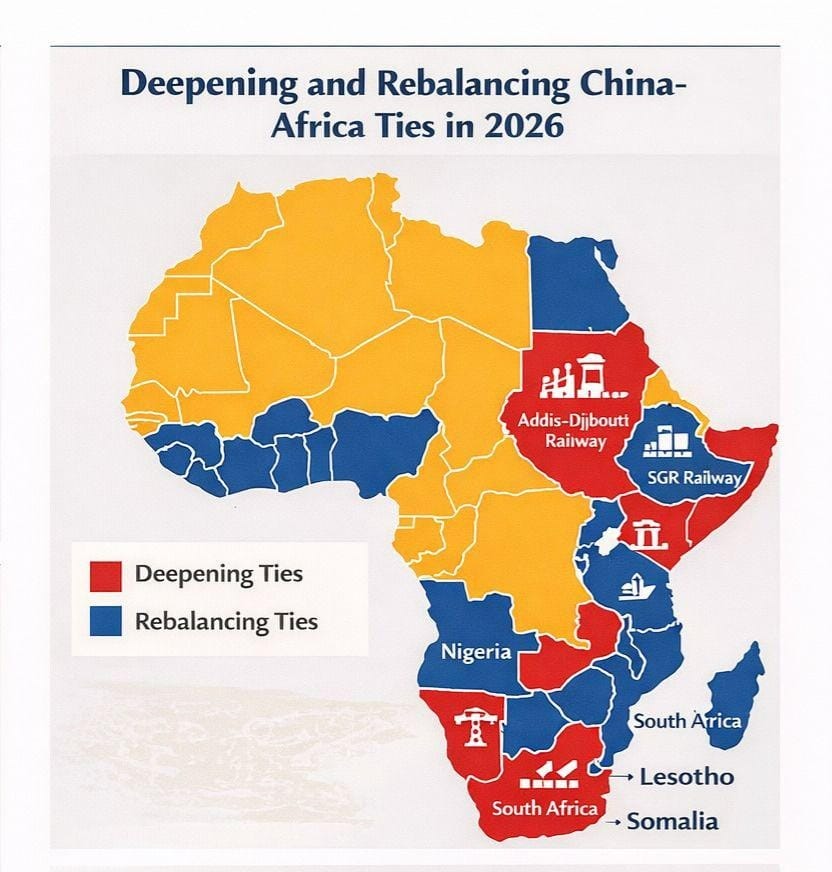
African countries deepening economic and diplomatic ties with China in 2026, highlighting major infrastructure projects driving bilateral engagement
Ethiopia
China and Ethiopia established diplomatic relations in 1970, but the partnership deepened decisively after 2005, when Ethiopia adopted a state-led development model focused on industrial expansion. During the 2010s, China emerged as Ethiopia’s largest bilateral lender and infrastructure contractor.
The most transformative project remains the Addis Ababa–Djibouti Railway, completed in 2016. The electrified line reduced cargo transit times from days to under 12 hours, reshaping trade logistics and anchoring Ethiopia’s export ambitions. Chinese firms also developed industrial parks such as the Eastern Industrial Zone, attracting textile, leather, and light manufacturing companies supplying global markets.
By 2026, cooperation extends beyond transport and construction. China supports Ethiopia’s manufacturing exports, telecommunications networks, and skills training programs. Ethiopia’s continued alignment reflects Beijing’s willingness to back industrial policy, absorb exports, and support large-scale development with minimal political conditions.
Kenya
Kenya’s diplomatic relationship with China dates back to 1963, immediately after independence, but engagement remained modest until the early 2000s. The turning point came in 2014 with the financing and construction of the Mombasa–Nairobi Standard Gauge Railway (SGR).
While the SGR sparked domestic debate over cost and returns, it fundamentally altered freight movement between Kenya’s main port and inland regions. China has since remained Kenya’s largest source of bilateral infrastructure financing.
By 2026, the relationship has evolved toward trade and value addition. Kenya benefits from expanded zero-tariff access for key exports including tea, coffee, and horticultural products, alongside selected manufactured goods. The deepening of ties reflects Kenya’s position as a regional logistics hub and China’s interest in East Africa’s consumer and export markets.
Tanzania
China and Tanzania share one of Africa’s longest diplomatic relationships, established in 1964. The partnership was cemented by the Tanzania–Zambia Railway, built in the 1970s to connect landlocked Zambia to the port of Dar es Salaam.
In the 2010s and 2020s, China re-emerged as a key investor in ports, energy, and mining-related infrastructure. Tanzania’s geographic position makes it a natural gateway for multiple landlocked economies.
As of 2026, China remains deeply involved in port upgrades, industrial parks, and mineral transport corridors. Tanzania’s political stability and export potential explain why ties have continued to deepen rather than plateau.
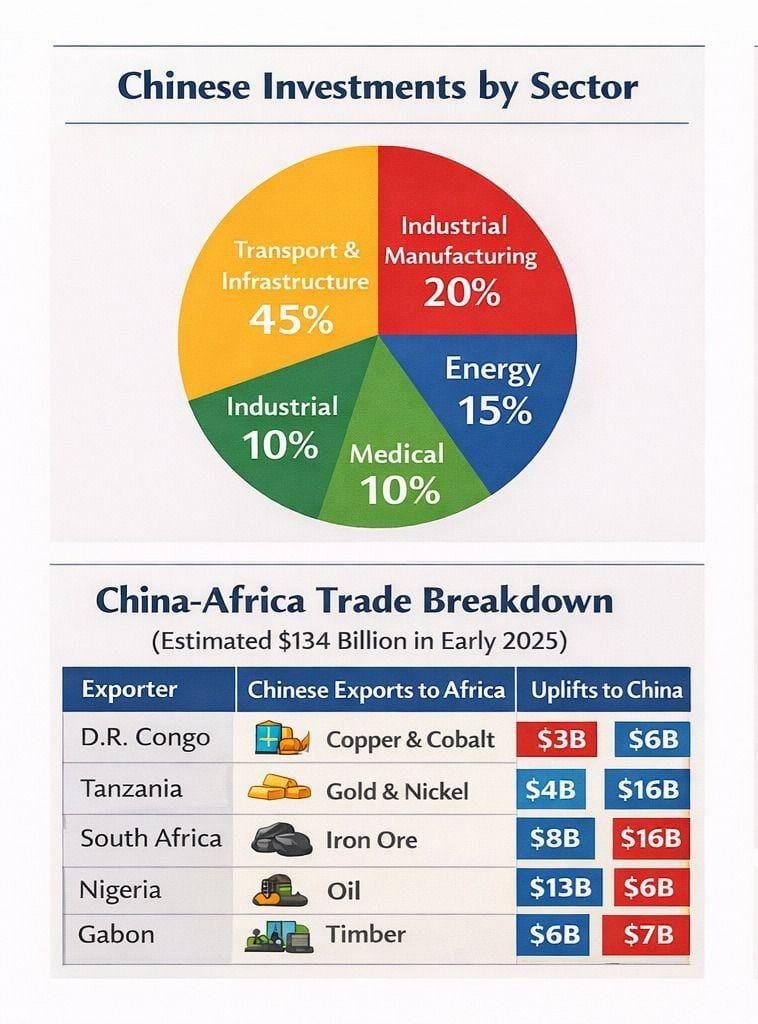
Sectoral breakdown of Chinese investments in Africa, 2026. Transport, energy, industrial, and healthcare projects highlight priority areas
Lesotho
China established relations with Lesotho in 1983, though economic engagement remained limited for decades. Momentum increased after 2020 with expanded duty-free access for African exports.
Lesotho’s textile and apparel sector has benefited from Chinese-backed manufacturing and improved market access. By 2026, exports to China include garments, agricultural products, and niche manufactured goods, reflecting a gradual broadening of trade beyond traditional destinations.
Somalia
China and Somalia first established diplomatic ties in 1960, but relations collapsed during decades of instability. Re-engagement began after 2012 with the formation of Somalia’s federal government.
By 2026, China’s interest is shaped by Somalia’s strategic location along key maritime routes. Engagement focuses on diplomatic presence, infrastructure rehabilitation, and long-term positioning rather than immediate large-scale investment.
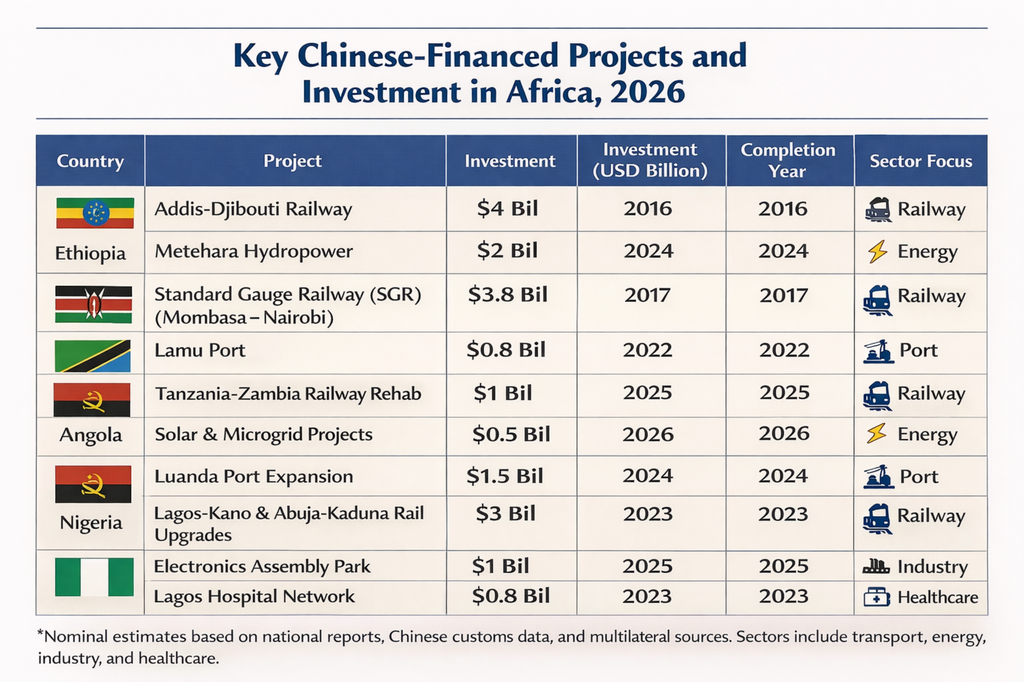
Key Chinese-financed infrastructure projects and trade investments in Africa, 2026. Includes project type, estimated investment value in USD, completion year, and sector focus (transport, energy, industry, healthcare). Figures are nominal estimates from national reports, Chinese customs data, and multilateral sources.
Countries Rebalancing Away from Heavy Dependence on China
South Africa
South Africa recognized China in 1998, with ties deepening after joining BRICS in 2010- a group of emerging economies including Brazil, Russia, India, China, and South Africa, which seeks to influence global financial governance. While China remains a major trading partner, South Africa has diversified engagement with the EU and U.S. in renewable energy, critical minerals, and manufacturing. Chinese trade volumes with South Africa reached an estimated twenty billion dollars in 2026. Energy projects now include wind and solar farms funded through European and South African collaboration. China became its largest trading partner by volume.
Over time, concerns emerged around trade imbalances and limited industrial gains. South Africa has since expanded engagement with the European Union and the United States, particularly in renewable energy, critical minerals, and advanced manufacturing.
By 2026, the approach reflects recalibration rather than withdrawal. China remains important, but diversification now anchors strategy.
Angola
Angola’s post-war reconstruction in the early 2000s relied heavily on Chinese oil-backed lending. While this accelerated infrastructure delivery, it also created exposure to oil price swings and repayment pressure.
From 2018 onward, Angola began broadening its partnerships. By 2026, it maintains strong ties with China while actively courting U.S., European, and Gulf investors in agriculture, energy diversification, and logistics.
Nigeria
Nigeria and China established diplomatic ties in 1971. Infrastructure cooperation expanded after 2010, but Nigeria has consistently avoided overconcentration.
Engagement with China on rail, power, and technology continues alongside deeper ties with Western partners in finance, security, and digital innovation. Nigeria’s approach reflects strategic balance rather than dependency.
Trade, Minerals, and Renewable Energy Dynamics
China and Africa's total trade reached record highs by 2025, with trade volume hitting approximately 134billion dollars in the first five months of 2025 alone up 12.4 percent year-on-year, reflecting China's position as Africa's largest partner for over a decade.
African nations export raw materials and minerals that are central to global supply chains for technology and renewable energy including copper, cobalt, iron ore, oil, and timber. Minerals such as copper and cobalt from the DRC and Zambia are essential for lithium‑ion batteries and electric vehicle components, linking African resource endowments directly to global green technology production.
Chinese renewable tech exports particularly solar panels, lithium batteries, and electric vehicles have grown sharply, sometimes by double‑digit percentages in recent years, supporting Africa’s push to expand energy access and reduce reliance on fossil fuels.
Why China’s Diplomacy in Africa Looks Different in 2026
Africa’s interaction with China in 2026 has practical implications for citizens, policymakers, and economic actors. Who benefits most? Countries that combine Chinese capital with strong negotiating leverage like Kenya negotiating zero‑tariff export access or Ethiopia aligning railway infrastructure with export corridors, see both infrastructure and value‑chain growth. Are there risks? Yes: dependency on a single partner can expose economies to debt sustainability issues, technology shortfalls, or supply chain disruptions. How does diversification help? Engaging the EU, U.S., India, and Turkey brings alternative financing terms, technology transfer opportunities, and competitive supplier markets, strengthening economic resilience. Are students and workers affected? Chinese scholarship programs, vocational training, and technical exchange initiatives have expanded, especially in engineering, manufacturing, and digital sectors, complementing domestic capacity building.
Conclusion
By 2026, China remains a core partner in Africa’s global engagement ecosystem, but its relationships have matured. Where ties deepen, African states secure transformational infrastructure, industrial capacity, and market access; where countries rebalance, they prioritize economic sovereignty, diversified technology sources, and sustainable financing frameworks. Africa today negotiates on performance metrics rather than capital alone, a sign of increasing agency in a multipolar global order.