Table of Contents
1. Uber agrees to buy Delivery Hero, pulling Glovo's African operations under one owner
Uber launched a $14.8 billion all-cash offer on July 16 for Germany's Delivery Hero at €41.50 a share, a premium of about 34 percent, in a deal that would fold Glovo's operations across Kenya, Nigeria, Uganda, Morocco, Tunisia, Côte d'Ivoire and Ghana into Uber's network. Uber, already Delivery Hero's largest shareholder, needs acceptances from holders of at least 50 percent plus one share and expects to close in the second half of 2027, pending regulators. To ease competition concerns, Delivery Hero agreed to sell operations in 14 markets to SSW Partners, while Prosus will tender its roughly 17 percent stake.
Why it matters: In several African cities Uber Eats and Glovo were the two biggest names in food and grocery delivery, so putting them under one owner hands Uber pricing power that competition regulators from Nairobi to Rabat now have to weigh. The deal reveals how the global delivery giants see Africa, as a growth prize worth consolidating rather than contesting. Watch whether African authorities extract remedies or wave the merger through, because that answer sets a precedent for how much concentration the continent's digital economy will tolerate.
Source: allAfrica (Reuters) / TechMoran / CIO Africa
2. West Africa's regional bourse pauses as investors take profits on Ecobank
The BRVM Composite and BRVM-30 indices each slipped 0.27 percent on July 17 to close at 479.92 and 228.34 points, dragged by Ecobank's ETI TG, which fell 6.41 percent and shed about 90.4 billion CFA francs in value while still sitting up more than 217 percent this year. Sucrivoire rose 7.40 percent to 3,920 CFA francs, with AGL and UNIWAX also gaining. The Abidjan exchange has run hot through 2026, with Sucrivoire up around 190 percent even after posting an $11 million loss.
Why it matters: One day of profit-taking is not a turn, but the BRVM's 2026 melt-up rests on thin volumes and a short list of names, which is how frontier rallies feed on themselves in both directions. Ecobank giving back gains while a loss-making sugar producer keeps climbing shows prices detaching from fundamentals, the oldest warning sign in a young market. A sharp reversal would sour the first-time retail savers the exchange spent years recruiting.
Source: allAfrica (Daba Finance) / Daba Finance via allAfrica
3. SADC ministers endorse new security measures as eastern Congo deteriorates
The SADC Ministerial Committee of the Organ closed its 28th session in Salima, Malawi on July 17, adopting measures on peace, security and democratic governance and voicing concern over the worsening security and humanitarian situation in eastern Democratic Republic of Congo. Malawi's foreign minister George Chaponda, who chairs the committee, pressed members to deepen cooperation on Congo, Madagascar and Mozambique. Ministers also conveyed condolences over the Ebola outbreak in the country's east.
Why it matters: SADC keeps reaffirming its commitment to eastern Congo while the situation there gets worse, a gap between communiqué language and facts on the ground that the bloc has not closed. The real test is the Panel of Elders report and whether member states fund and staff any actual deployment. For Congo, diplomacy that moves at the speed of ministerial sessions keeps losing ground to armed groups that move faster.
Source: allAfrica / Daily News (Tanzania) / Nyasa Times
4. Somalia's cabinet dissolves the Chamber of Commerce board, and the chamber refuses to go
Somalia's Council of Ministers, meeting Thursday under Prime Minister Hamza Abdi Barre, dissolved the board of the Somali Chamber of Commerce and Industry, removed chairman Mahmoud Abdikarin Gabeyre and named Yasin Mahmoud Ibaar interim chair with a mandate to organize elections within two years. The chamber rejected the move as unlawful. Deputy chairman Abdirahman Galaanbi said the body's leaders come only through a member vote, noting the last recognized election was held in 2017.
Why it matters: The fight is over whether Somalia's private sector answers to its members or to the state, and those members generate a large share of the government's own revenue. By installing an interim chair over a body that has represented Somali business at international investment forums, the cabinet risks politicizing the one institution foreign partners read as independent. How this standoff ends will tell traders and investors whether Mogadishu treats the private sector as a partner or a subordinate.
Source: Hiiraan Online / The Standard / Citizen Digital
5. Zimbabwe's government insists remittances will hold as citizens stream back from South Africa
A spokesperson in President Mnangagwa's office said on July 17 that the return of nearly 100,000 Zimbabweans from South Africa since May, driven by anti-migrant pressure, will not dent diaspora remittances, which have reached $1.55 billion so far and are projected to roughly double by year-end. Officials argue the professionals who send most of the money remain abroad. The government says it is scaling up reintegration through vocational training and Empower Bank credit.
Why it matters: Remittances are one of Zimbabwe's largest sources of hard currency, so the claim that a mass return leaves them untouched is a bet on the makeup of the diaspora rather than a certainty. Even if the money holds, tens of thousands of job seekers arriving into a weak economy is a fiscal and political strain on its own. Watch the reintegration budget, because training schemes and bank credit are easier to announce than to fund.
Source: New Zimbabwe / allAfrica / Zimbabwe Situation
6. South Africa's shop closures harden a fight over who gets to trade
In Nkowankowa township outside Tzaneen, businesses ordered shut during a Greater Tzaneen municipal compliance sweep stayed closed almost two weeks on, with officials citing trading, health and bylaw breaches as they worked alongside police and Home Affairs. The same week, Public Protector Kholeka Gcaleka reported systemic failures in how the state oversees spaza shops, pointing to thin municipal health capacity and possible fronting arrangements in which citizens register businesses for undocumented operators. The closures swept up a clothing franchise, butcheries and grocery outlets and drew mixed reactions from residents.
Why it matters: Framed as bylaw enforcement, these closures sit inside a national argument over whether foreign-run shops should exist at all, and the economics cut against the politics. Foreign-owned spaza shops often undercut local rivals through bulk buying and longer hours, so clearing them tends to raise prices for the same residents applauding the crackdown. The Public Protector's findings move the story from street-level resentment to a failure of the state's own oversight, which is the harder problem to fix.
Source: allAfrica (Scrolla) / TimesLIVE / EWN
7. Kogi forces rescue abducted exam candidates as the governor rules out ransom
Security forces in Kogi State freed four people, a school principal, a NECO official and two students, abducted on Tuesday from an unauthorized examination centre at a shuttered school in Dekina, with the rescue confirmed Thursday and Governor Ahmed Ododo receiving the freed captives Friday in Lokoja. Ododo credited a joint operation by the army, police, DSS and vigilante groups and said his government would not pay kidnappers, warning that gunmen entering the state would not return to where they came from. He ordered an inquiry into why the exam ran at an isolated, previously closed site.
Why it matters: The rescue is a win, but the detail that a national exam was held at an abandoned, security-flagged school is the real scandal, and it points at institutional failure rather than fate. A no-ransom stance deters kidnapping only if the state can consistently recover victims by force, which is expensive and far from guaranteed. Kogi is one theatre of a wider Nigerian problem where school sites keep becoming soft targets.
Source: allAfrica (Leadership) / Vanguard / The Guild
8. FAO warns swinging coffee, cocoa and tea prices are squeezing African growers
A new Food and Agriculture Organization report says weather shocks, crop disease and shifting supply and demand have driven sharp price swings in coffee, cocoa and tea, with smallholders absorbing the most risk across the value chain. The FAO found that global price gains pass only partly to farmers, while a large share of value accrues in processing, distribution and retail. It called for coordinated policy to build steadier, more inclusive value chains in economies that lean on these crops for export earnings.
Why it matters: For Ghana, Côte d'Ivoire, Ethiopia and Kenya, this is a public-finance story as much as a farming one, since export receipts and government revenue ride on prices set far from the farm. The report's core finding, that farmers eat the volatility while middlemen capture the margin, is the case for the producer blocs and floor prices West African growers have been demanding. The open question is whether governments coordinate or keep responding country by country, which is how the current split persists.
Source: Africanews / Farmers Review Africa
9. A Somali suspect is returned to the United States over a $250 million Covid-fraud case
US authorities said Friday that a Somali man accused of a central role in a roughly $250 million pandemic-relief fraud scheme has been returned from Somalia to face federal charges, according to a statement attributed to the US Attorney's office. The case is one of the largest Covid-era fraud prosecutions tied to diverted relief funds. Details on the transfer arrangement were limited in early reporting.
Why it matters: A cross-border return in a case this size signals working law-enforcement cooperation between Washington and Mogadishu at a moment when their security relationship is otherwise strained. For Somalia, being seen to hand over a suspect rather than shelter one is reputational currency with Western partners. Treat the specifics as provisional until US court filings confirm them.
Source: Axadle
10. A school bus crash in eastern Uganda kills 20 children
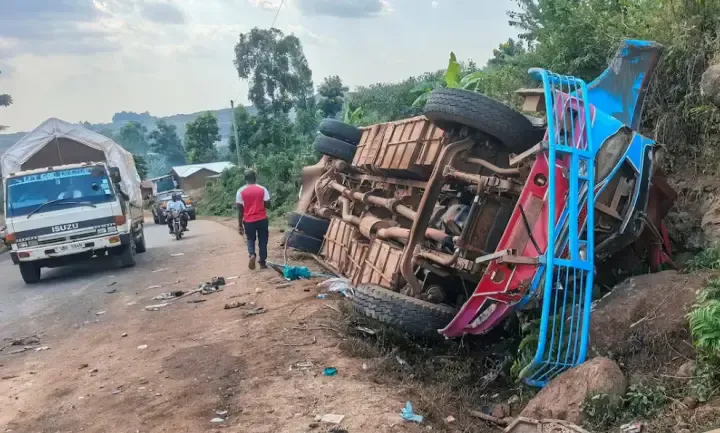
Twenty pupils and one adult died on Friday when a bus carrying children from King David Junior School in Kampala overturned in Kapchorwa District as the group returned from a trip to Sipi Falls. Police said the driver lost control, struck a large roadside stone and overturned, and that three adults and several children were injured. The wreck adds to a grim record, following a 2025 highway collision that killed 46 and the 5,144 road deaths Uganda logged in 2024. Following the incident, the Ugandan government has banned all school excursions across the country with immediate effect.
Why it matters: Behind the grief is a policy failure that recurs because nothing structural changes, from vehicle inspection to driver oversight to enforcement on rural roads. Uganda's road-death toll is a state-capacity problem, and school transport keeps exposing it. The test is whether this crash produces enforceable safety rules or another round of condolences before the next one.
Source: Africanews (corroborated by AP and a Uganda Police statement)
Africa Today is The African Exponent's daily briefing on the continent as it is. Summaries are written by our editors. Click through to the original sources for full reporting.